
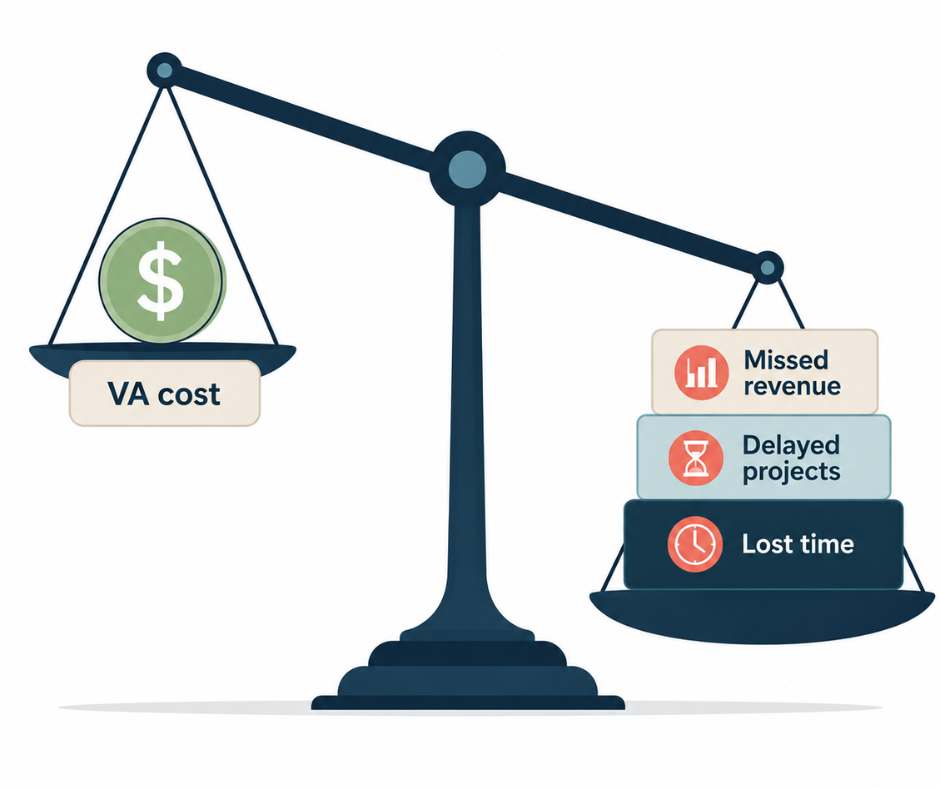
One of the most common conversations I have with business owners goes something like this:
“I know I need help, but I’m not sure I can afford to hire someone.”
It’s a reasonable concern. Payroll is often one of the largest expenses a business faces. When you’re responsible for cash flow, customer satisfaction, and keeping the business healthy, every hiring decision matters.
If you’ve run a business long enough, you’ve probably experienced a situation where laying off employees was the solution to handling negative cash flow. And I’ve never met a business owner who enjoys that process. Experiences like that can create the belief that staffing is simply an expense you either can afford or cannot afford.
The problem is that this isn’t a workable concept for long-term growth.
The proper mindset is to view staffing as an investment. Instead of asking whether you can afford an employee, ask what return that investment will generate. When evaluating a hiring decision, consider how that employee can help bring back five to ten times what they are being paid through increased productivity, improved customer service, expanded capacity, stronger sales, or better operational efficiency.
When you begin looking at staffing through the lens of return on investment, your hiring decisions change. You start hiring more strategically. You start identifying roles that create measurable value. And ultimately, you position your business to expand rather than simply survive.
But over the years, I’ve learned that the better question is often not, “Can I afford to hire?”
The better question is:
“Can I afford not to?”
The shift from ‘can I afford this?’ to ‘what does this make possible?’ is one of the most important mindset transitions a business owner can make. It’s also one that experienced operators working with a virtual staffing agency tend to make early because they’ve seen the math play out. The sections below walk through exactly why the cost of not hiring is often more expensive than the cost of bringing on the right support.
The Cost Most Owners Never Calculate
Opportunity Cost: What Those Hours Are Really Worth
Most owners track what staff costs them. Few track what staying overloaded costs them. Use this as a rough benchmark your actual hourly value as the owner will likely be higher.
| Task Owner Does Weekly | Hrs / Week | Est. Cost @ $100/hr* | Revenue Risk |
| Administrative work | 10 hrs | $1,000 | 🔴 High |
| Scheduling management | 5 hrs | $500 | 🟠 Medium |
| Routine email responses | 4 hrs | $400 | 🟠 Medium |
| Data entry & reporting | 3 hrs | $300 | 🟡 Low–Med |
| Lead follow-up | 4 hrs | $400 | 🔴 High |
| Total | 26 hrs | $2,600/wk | — |
*Estimated owner opportunity cost per hour based on revenue-generating activity value. The goal is not precision, it is perspective.
Most business owners carefully calculate the cost of bringing on a new team member.
They look at wages, taxes, benefits, equipment, training, and onboarding costs.
What often gets overlooked is the cost of not hiring.
Consider the business owner who spends:
- Ten hours per week on administrative work
- Five hours managing scheduling
- Several hours answering routine emails
- Additional time handling data entry and reporting
Those hours have a cost.
Every hour spent on administrative tasks is an hour not spent:
- Building customer relationships
- Generating new business
- Improving operations
- Developing employees
- Creating strategic plans
- Expanding revenue opportunities
The opportunity cost can be enormous.
The Trap of Doing Everything Yourself
The story above — a business shrinking to a quarter of its size before the owner finally built a team is more common than most founders want to admit. The decision to hire a virtual assistant or bring on dedicated offshore support is rarely about finding extra money. It’s about deciding that your time is worth protecting. If you’re still working through whether your business has a people problem or a systems problem, our earlier post on why your business doesn’t have a staffing problem — it has a capacity problem is worth reading before you get to the hiring conversation.
Many entrepreneurs are exceptionally capable people.
That’s often how they became successful in the first place.
The challenge is that capable people can become too good at handling everything.
Instead of asking for help, they continue adding responsibilities to their own plate.
For a while, this approach works.
Eventually, however, something starts to suffer.
It may be customer follow-up.
It may be marketing consistency.
It may be growth initiatives.
It may simply be personal time and quality of life.
The business continues operating, but growth becomes harder to achieve.
I once had a business partner who believed he was saving money by working 16 or more hours a day and doing everything himself. On the surface, it seemed like a disciplined approach. In reality, it became a major growth constraint. Over time, his company declined to roughly one-quarter of its original size before he finally realized he needed to build a team. Fortunately, once he brought in the right people, the business was positioned for a dramatic turnaround and was on track to increase both gross and net profit by approximately 600%. Not every business gets that opportunity. He was fortunate. Many companies never recover from the damage caused by trying to do everything alone for too long.
Capacity Creates Revenue
One of the most important lessons I’ve learned as a business owner is that growth requires capacity.
If your calendar is already full, adding more customers becomes difficult.
If your team is already stretched, taking on additional work becomes challenging.
If every decision flows through you, expansion slows down.
Hiring isn’t simply about reducing workload.
It’s about creating capacity.
Capacity creates opportunities.
Opportunities create revenue.
Revenue creates growth.
That’s why many successful businesses hire before they feel completely comfortable doing so.
They understand that capacity must often be built before growth arrives.
Looking Beyond Payroll
When evaluating a hiring decision, consider questions such as:
- What opportunities am I currently unable to pursue?
- What tasks consume my time but don’t require my expertise?
- What projects have been delayed because I’m too busy?
- How much revenue could additional capacity create?
- What would happen if I had ten more productive hours every week?
These questions often reveal that the true cost isn’t hiring.
The true cost may be remaining overloaded.
A Practical Approach
I’m a strong believer in financial discipline.
Businesses should be built on healthy cash flow, not reckless spending.
That doesn’t mean avoiding investment.
It means making smart investments that produce measurable returns.
The goal isn’t to hire simply for the sake of hiring.
The goal is to place the right support in the right role so the business owner can focus on higher-value activities.
When done correctly, the additional capacity often produces returns that far exceed the cost of the support itself.
Why Offshore Staffing Has Become So Popular
Traditional Hiring vs. Offshore Staffing: A Quick Comparison
For business owners weighing the investment, this comparison helps clarify why offshore staffing has become the preferred capacity-building tool for lean, growth-focused companies.
| Factor | Traditional Local Hire | Offshore Remote Support |
| Monthly cost | $4,000–$6,000+ | $800–$2,000 |
| Benefits & taxes | Yes — significant | No |
| Time to hire | 4–12 weeks | 1–2 weeks |
| Office/equipment cost | Often required | None |
| Scalability | Slow & costly | Fast & flexible |
| Capacity added | Yes | Yes |
Both options add capacity. Only one does it without requiring you to overextend your cash flow to get there.
Many business owners recognize the need for help but hesitate because traditional hiring can feel financially overwhelming.
That’s one reason offshore staffing has become such an attractive option.
It allows companies to add capable support while maintaining financial flexibility.
Administrative tasks, customer service functions, scheduling, data management, lead follow-up, marketing support, and many other responsibilities can often be handled effectively by dedicated offshore team members.
The result is more capacity without the same financial burden that often accompanies traditional hiring.
Final Thoughts
If you’re feeling overwhelmed, the answer isn’t always to work harder.
Sometimes the answer is to create more capacity.
The most successful business owners I’ve met eventually realize that growth is not about how much they can personally accomplish.
It’s about building systems and teams that allow the business to accomplish more.
The next time you find yourself asking, “Can I afford to hire?” consider asking a different question:
“What opportunities am I missing because I haven’t hired yet?”
The answer may be worth far more than the cost of additional support.
Frequently Asked Questions
Q1. At what point should a business owner consider hiring support?
A useful rule of thumb: if you are consistently spending more than ten hours per week on tasks that do not require your direct expertise, the capacity argument for hiring has already been made. The question at that point is not whether to hire — it is what role to fill first and how to do it in a way that maintains financial discipline.
Q2. What tasks are best suited for an offshore virtual assistant?
Administrative work, appointment setting, lead follow-up, customer communication, data entry, reporting, social media coordination, and research are among the most common. These are high-frequency, process-driven tasks that a well-matched offshore team member can own fully — freeing the business owner for higher-value activity.
Q3. How do I calculate the ROI of hiring a virtual assistant?
Start by estimating your effective hourly value as the owner — what an hour of your time generates in revenue or strategic output when used well. Then multiply that by the hours a VA would recover for you each week. Compare that figure to the monthly cost of the VA. In most cases, even a conservative estimate produces a return that justifies the hire within the first 30 to 60 days.
Q4. Is working with a personal assistant staffing agency different from hiring a freelancer directly?
Yes, meaningfully so. A personal assistant staffing agency handles candidate sourcing, vetting, matching, and often provides ongoing support if the placement needs adjustment. Hiring a freelancer independently places all of that responsibility on the owner — who is usually already stretched. For business owners hiring support for the first time, the agency model significantly reduces the risk and time investment of getting it right.
Q5. What if I try offshore staffing and it doesn’t work out?
The risk with offshore staffing is generally lower than with a traditional local hire precisely because the financial commitment is smaller and the timeline to adjust is shorter. A reputable executive assistant staffing agency or virtual staffing partner will have a process for addressing fit issues quickly — rather than leaving you locked into a costly arrangement that isn’t working.
Ready to Create Capacity Without Overextending Your Budget?
The business owners who scale consistently are not the ones who figured out how to do more themselves. They’re the ones who decided their time was worth protecting — and built the support structure to back that decision. If you’re at that point, partnering with a dedicated executive assistant staffing agency is one of the most direct ways to reclaim the hours your business needs from you most. The capacity is available. The question is whether you’re ready to use it.
Expansion Desk helps business owners add dedicated offshore team members who provide real support while maintaining financial discipline. If you’re ready to spend less time buried in tasks and more time focused on growth, we’d love to show you what’s possible.