Open LinkedIn any morning and you will hear three things before your coffee cools. AI will replace your staff. Every competitor already runs on it. And if you are not automating everything this quarter, you are finished.
Plenty of owners feel a mix of pressure and doubt. They have tried a chatbot, maybe hired a dedicated virtual assistant, and they still cannot tell which claims are real. So we did what a good editor does with a loud headline: we checked it against the data.
The short answer
- AI use is real but uneven. A U.S. Chamber of Commerce survey found 66% of small businesses use some form of AI in 2026. The Census Bureau, asking a stricter question, puts it near 20%.
- Productivity gains are real but not automatic. The biggest measured gains go to less experienced workers on well-defined tasks.
- Job loss is narrower than the headlines suggest. The clearest decline so far is among workers aged 22 to 25 in the most exposed jobs.
- AI does not run itself. Someone still has to brief it, check it and act on what it produces.
Is AI actually taking over small business?
No, not in the way the headlines describe. AI is spreading fast as a tool inside small businesses, mostly for marketing, customer service and accounting tasks. But most firms use it for parts of jobs, not whole jobs, and the measured gains depend on people who brief it, check its output and decide what to do next.
Five claims, fact-checked
| The claim | Verdict | In one line |
|---|---|---|
| Every small business is already using AI | Depends who is asking | 66% or about 20%, depending on the question |
| AI makes everyone far more productive | Half true | Big gains for beginners, little or none for experts |
| AI will replace your staff | Not yet | Losses so far are narrow and early-career |
| A few tools can run your back office | False | Output still needs a person to check it |
| Wait and you will fall behind for good | Too early to tell | Small firms are not adopting quickly either |
Claim 1: Every small business is already using AI
Verdict: Depends who is asking.
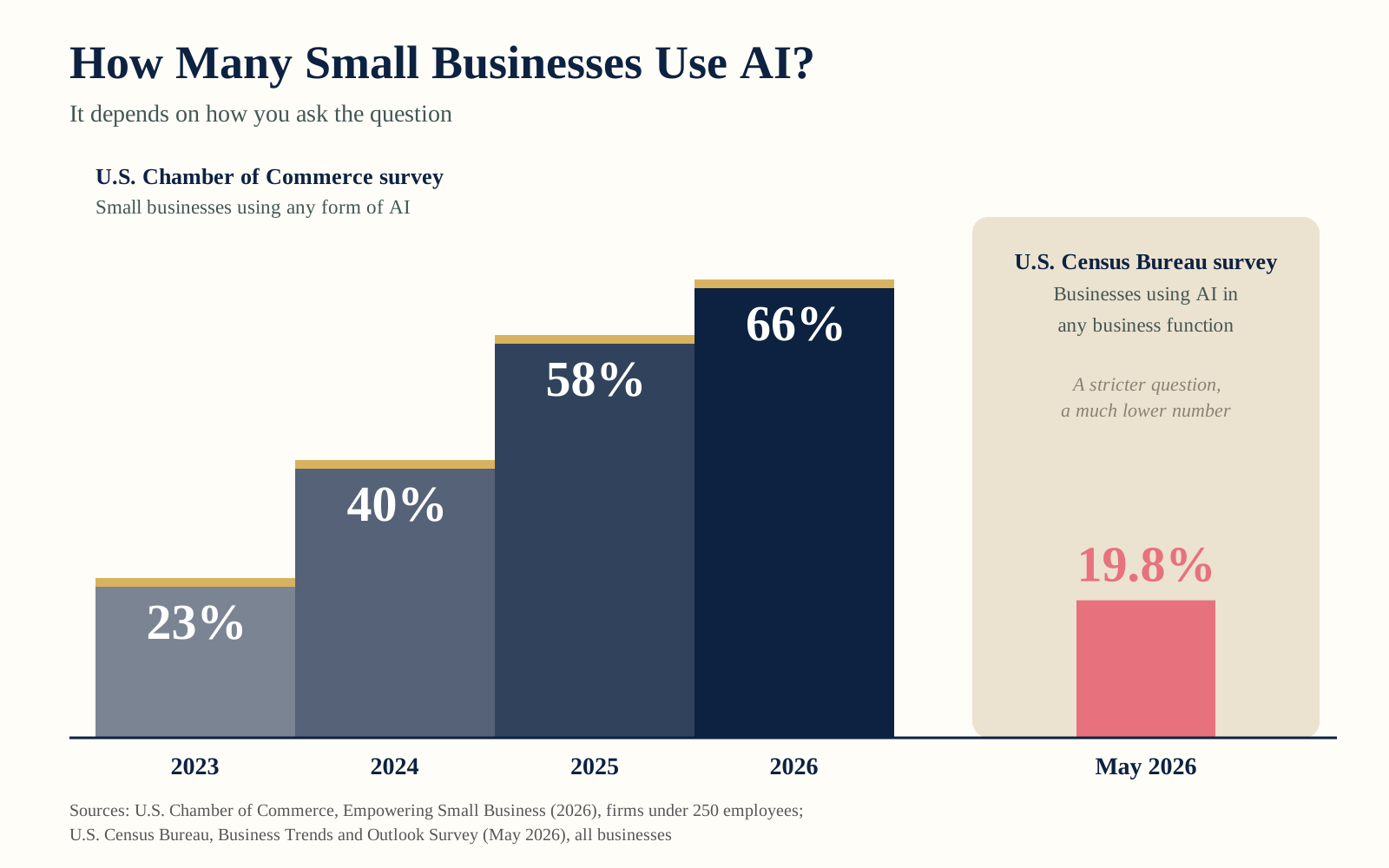
The U.S. Chamber of Commerce has surveyed small businesses every year since 2022. Its 2026 report, based on 3,732 firms with fewer than 250 employees, found 66% use AI, up from 58% in 2025, 40% in 2024 and 23% in 2023.
The Census Bureau tells a quieter story. Its Business Trends and Outlook Survey asks whether a business uses AI in any business function. As of May 2026, 19.8% said yes. Among firms with four or fewer employees, it was under 20%, and use among firms with fewer than 20 employees did not change significantly between December 2025 and May 2026.
Both can be true. Counting a chatbot used once gives a high number. Counting AI built into how the business runs gives a low one. The useful question is whether your business has one task where AI reliably saves time.
Claim 2: AI makes everyone far more productive
Verdict: Half true.
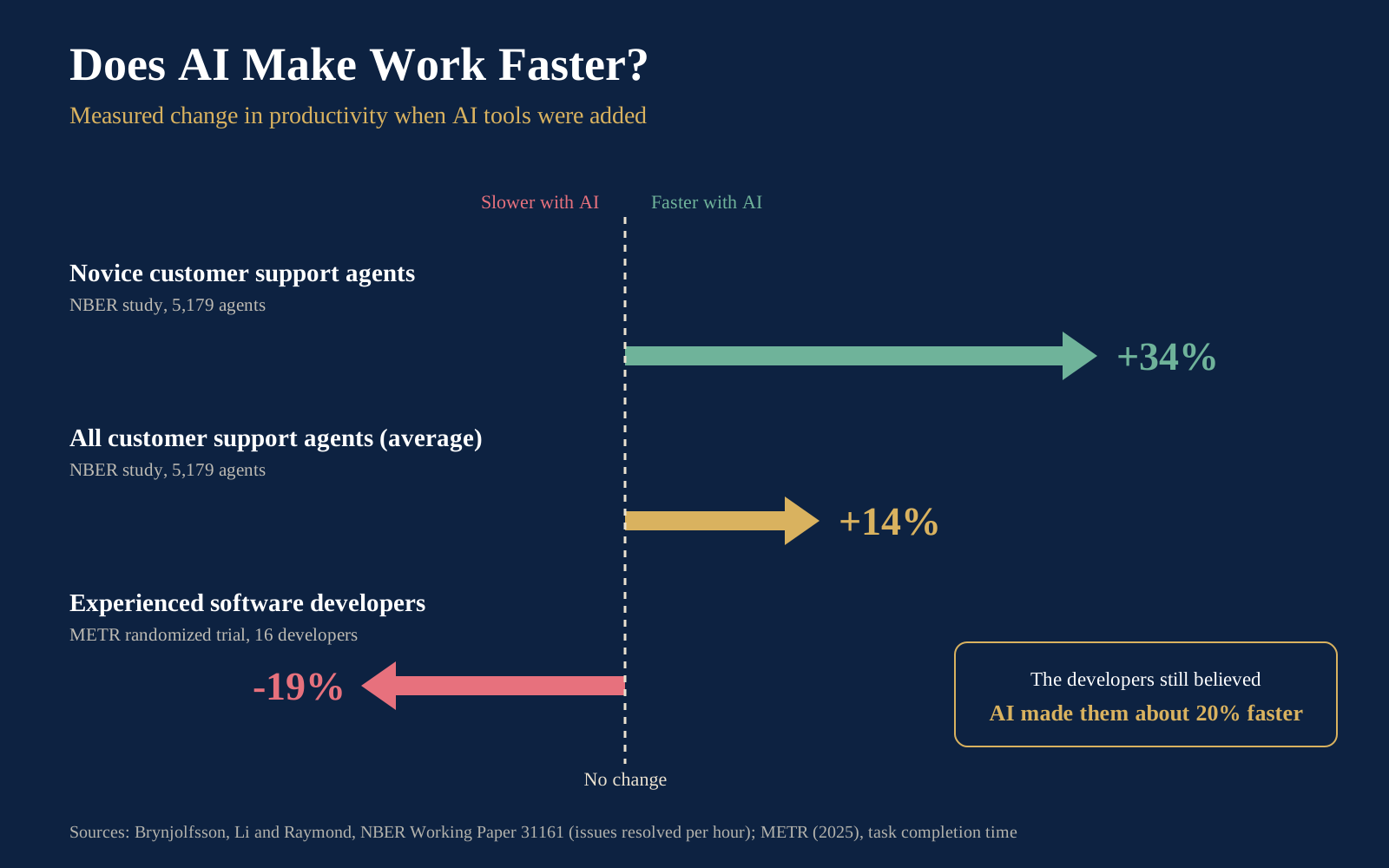
The strongest real-world evidence comes from a study of 5,179 customer support agents published by the National Bureau of Economic Research. An AI assistant raised issues resolved per hour by 14% on average and by 34% for novice and lower-skilled agents. The most experienced agents saw little change.
Now the other side. In a randomized trial by the research group METR, 16 experienced software developers worked on 246 real tasks. They expected AI to speed them up by 24%. With AI, they took 19% longer. Afterwards, they still believed it had made them about 20% faster.
The lesson: gains are largest on structured, repeatable work and smallest where an expert already knows the job. And feeling faster is not being faster, so measure first.
Claim 3: AI will replace your staff
Verdict: Not yet, and not broadly.
A Stanford study using payroll data found a 13% relative decline in employment for workers aged 22 to 25 in the occupations most exposed to AI. That is a real signal. But the same study found employment for more experienced workers in those jobs, and for workers in less exposed jobs, stayed stable or kept growing.
Inside small businesses, the Chamber survey points the same way. Among owners, 47% said AI is creating jobs today and 6% said it is enabling headcount cuts. 89% of AI-using firms grew their workforce, compared with 80% of firms not using AI. That is a correlation, not proof that AI caused the hiring, but it does not fit the replacement story.
What is changing is the shape of the work. Fewer hours go into first drafts and data entry, and more go into checking, following up and talking to customers. That often means you need a different kind of help, not less of it, which is the core of a staffing problem versus a capacity problem.
Claim 4: A few tools can run your back office
Verdict: False for most small businesses.
Among small businesses not using AI, the Chamber found the top barrier was concern about the quality of the tools, at 33%. Data privacy emerged as a notable new concern in 2026. Both are reasonable. AI can write a confident wrong answer, and someone has to catch it before a customer does.
Tools also do not chase. An AI can draft the follow-up email, but it will not notice the client went quiet, call the vendor about a late shipment or decide which of three urgent requests matters most. That judgment and follow-through is still a person’s job.
Claim 5: Wait and you will fall behind for good
Verdict: Too early to tell.
The Census data shows the smallest firms are not racing ahead. Use rose among businesses with 20 or more employees between December 2025 and May 2026, but not among smaller ones. Your direct competitors may be exactly where you are.
Learning still takes time. Owners who start with one small, measured use now will choose better later than those who wait and buy everything at once. Buying blindly is the bigger risk.
What is actually true: work is splitting into three lanes
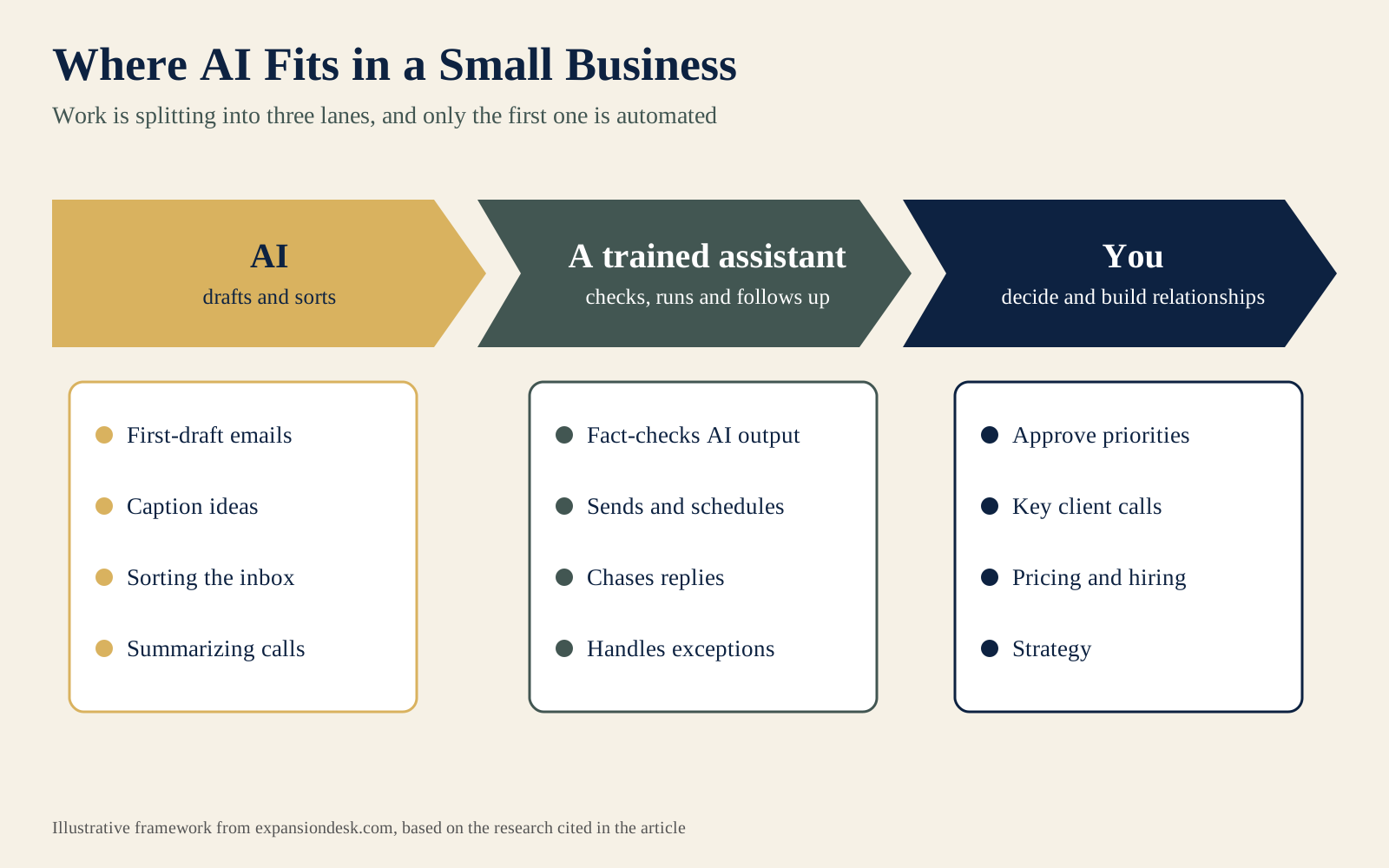
Across the research, one pattern holds. AI is good at the first pass. People are needed for the middle, where work gets checked, finished and followed up. And the owner stays at the end, making the calls that shape the business.
| Task | Where AI helps | Where a person is still needed |
|---|---|---|
| Inbox | Sorting and drafting replies | Deciding what matters and sending |
| Social media | Caption ideas and first drafts | Brand voice, timing and replies to comments |
| Customer support | Suggested answers to common questions | Upset customers and exceptions |
| Lead research | Pulling lists and summaries | Checking accuracy and personal outreach |
| Bookkeeping | Categorizing transactions | Reconciling, chasing invoices and judgment calls |
| Scheduling | Finding open slots | Handling conflicts and priorities |
This is why many owners now pair AI tools with a human assistant who knows how to use them. The assistant runs the middle lane, so the owner is not stuck checking every AI draft personally. If inbox and calendar are your heaviest load, executive assistant services are a common place to start.
A 30-day AI reality test for your business
Before you buy another subscription, run this simple test on one task.
- Pick one repetitive task you do weekly, such as follow-up emails or social captions.
- Time it for one week without AI. Write the number down.
- Try AI for two weeks on the same task, with a person checking every output.
- Track three things: time saved, errors caught and anything a customer noticed.
- Decide in week four: keep it, adjust it or drop it.
If the time saved is real after checking, keep it. If checking eats the savings, the task may suit a person better. Either way, you made the call on evidence, not on a headline. If you are weighing that kind of decision on cost, this guide on whether hiring a virtual assistant is worth it walks through the numbers.
When AI is not the right move
- The task involves sensitive customer, health or financial data and you have not checked how the tool stores it.
- Mistakes are costly or regulated, such as billing, legal wording or tax filings, and no one is reviewing the output.
- The work depends on a relationship, like a key client call or a difficult conversation.
- You have no clear process yet. AI speeds up a process; it does not invent a good one.
Frequently asked questions
Is AI going to replace small business employees?
Not broadly, based on current evidence. A Stanford study found a 13% relative employment decline for workers aged 22 to 25 in the most AI-exposed jobs, while employment for experienced workers stayed stable or grew. Most small businesses report using AI for parts of jobs.
How many small businesses use AI?
It depends on the survey. The U.S. Chamber of Commerce found 66% of small businesses used some form of AI in 2026. The Census Bureau, asking whether AI is used in any business function, found 19.8% of all businesses in May 2026.
What do small businesses use AI for most?
Marketing is the most common use. Among small businesses using AI, the Chamber’s 2026 report found 41% use it for marketing, 35% for customer experience and 31% each for accounting and managing customer relationships.
Does AI really make workers more productive?
Often, but not always. In one large study, AI raised customer support productivity by 14% on average and 34% for novices. In a controlled trial, experienced developers using AI took 19% longer on real tasks.
Should a small business use AI or hire a virtual assistant?
Many use both. AI handles first drafts and sorting, while a virtual assistant checks the output, finishes the work and follows up.
What is the safest way to start using AI in a small business?
Start with one repetitive, low-risk task, measure the time it takes without AI, then test AI for two weeks with a person checking every output. Keep it only if the savings hold up after review.
What to do next
Skip the loudest headline and run the 30-day test on one task this month.
Expansion Desk matches business owners with vetted, trained assistants, with a dedicated onboarding support team behind them. See how a virtual assistant for small business can run the middle lane, checking, finishing and following up, so AI saves you time instead of adding review work.
Not sure where AI fits and where a person fits? Book a free discovery call and bring the one task you want off your plate.
Sources
- U.S. Chamber of Commerce Technology Engagement Center and Teneo, Empowering Small Business: The Impact of Technology on U.S. Small Business (2026). uschamber.com
- U.S. Census Bureau, Large Firms With at Least 20 Employees Biggest AI Users (May 2026). census.gov
- Brynjolfsson, Li and Raymond, Generative AI at Work, National Bureau of Economic Research Working Paper 31161. nber.org
- METR, Measuring the Impact of Early-2025 AI on Experienced Open-Source Developer Productivity (2025). arxiv.org
- Brynjolfsson, Chandar and Chen, Canaries in the Coal Mine? Six Facts about the Recent Employment Effects of Artificial Intelligence, Stanford Digital Economy Lab (2025). siepr.stanford.edu

- How to Do a Time Audit as a Business Owner (Free Template) - November 11, 2026
- Everyone Is Talking About AI Taking Over Small Business, Here Is What Is Actually True - November 4, 2026
- What Successful Business Owners Do Differently When They Scale - November 4, 2026