

Two owners start the same year, in the same industry, with the same drive. Five years later, one runs a business that keeps growing while she takes a week off. The other is still answering every email himself and wondering why revenue has stalled. Here is what successful business owners do differently.
The difference is rarely talent or luck. It is a series of shifts in how the owner spends their time and how the business runs without them, often with help from a virtual assistant partner or a small team. This article breaks down the six shifts, what the research says about each and how to tell which stage you are in.
Executive summary
- Most businesses never reach the scaling stage. Of U.S. establishments that opened in 2013, 50.6% were still running after five years and 34.7% after ten, according to the Bureau of Labor Statistics.
- Systems matter as much as R&D. A Stanford-led study of more than 35,000 U.S. plants found structured management practices explain about a fifth of productivity differences, as much as R&D and twice as much as technology spending.
- Scaling leaders protect time on purpose. In Harvard’s study of 27 CEOs, 28% of work time was spent alone and 21% on strategy, even inside 62.5-hour weeks.
- The real shift is from doer to designer. Owners who scale stop being the engine of the business and start building the machine.
- You can move through the shifts one at a time. Start with the one that frees the most hours.
What do successful business owners do differently when they scale?
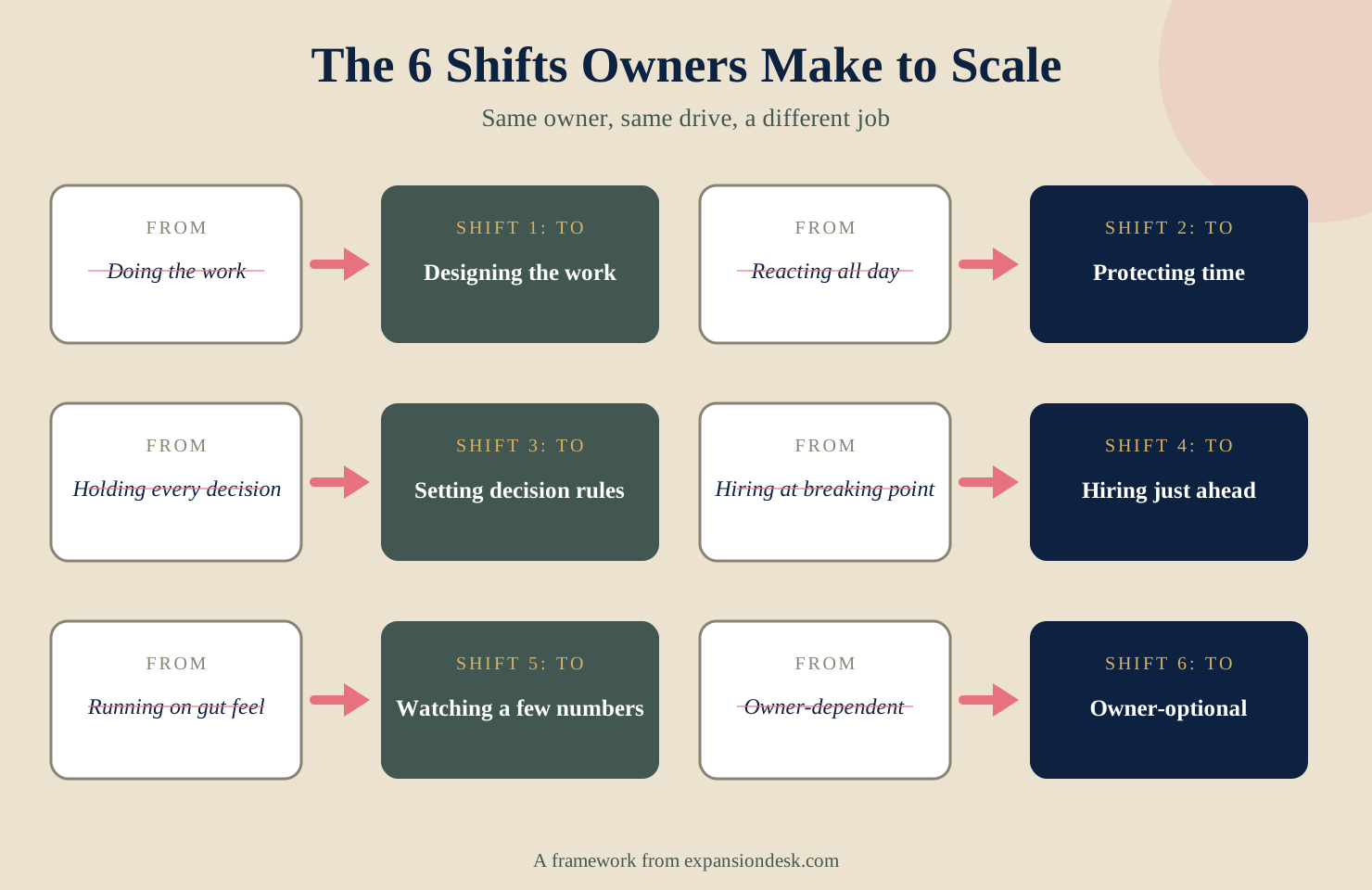
Successful business owners scale by changing their role, not just their effort. They move from doing the work to designing how it gets done, protect time for strategy, hand routine decisions to clear rules, bring in help before they hit a breaking point, track a few key numbers and build a business that can run without them for a week.
Why most businesses stall before they scale
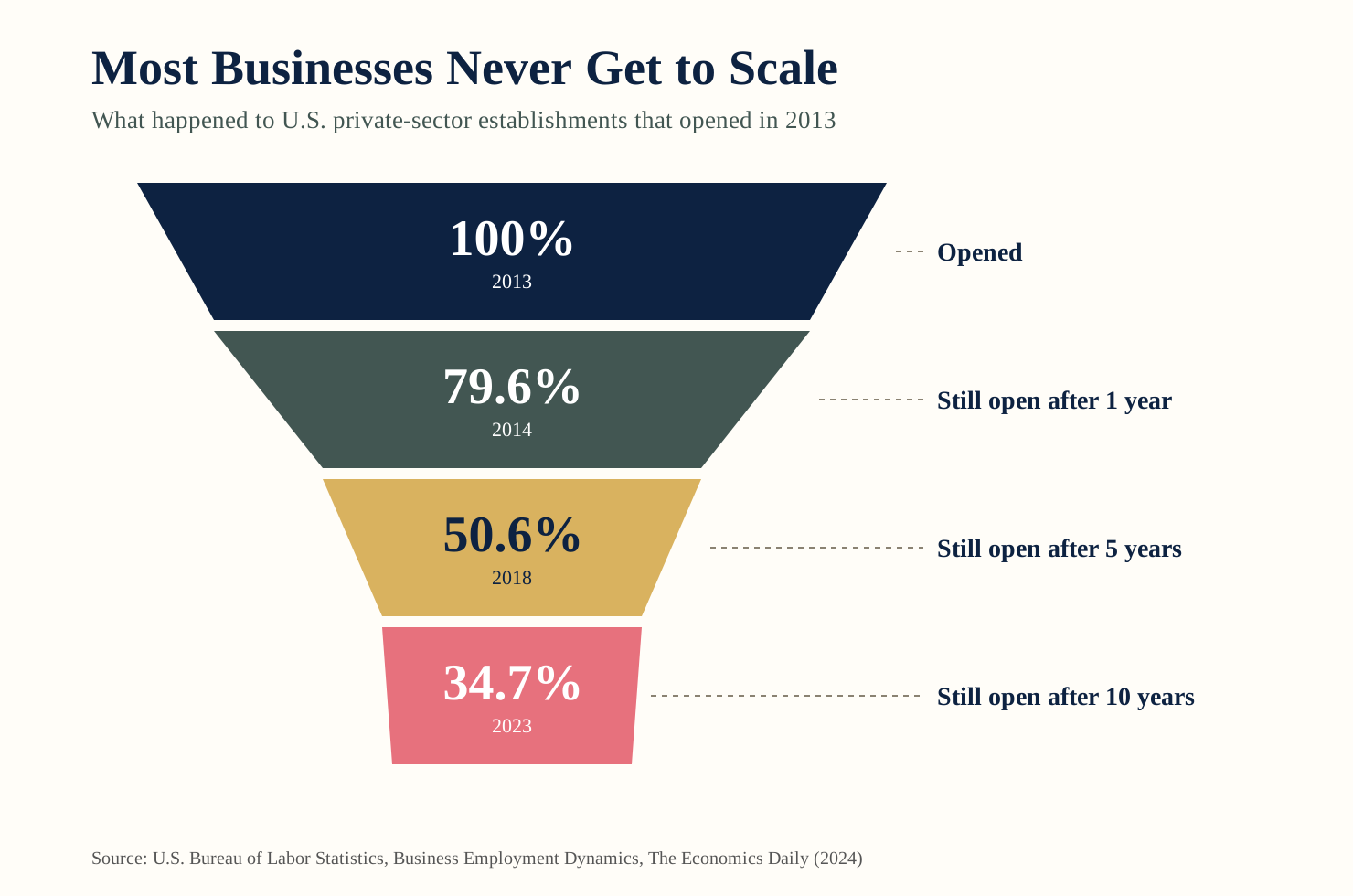
The Bureau of Labor Statistics tracked every private-sector establishment that opened in 2013. After one year, 79.6% were still operating. After five years, 50.6%. After ten, 34.7%.
Survival is not the same as scaling, and businesses close for many reasons: cash, market shifts and plain bad timing among them. But among owners who make it past the early years, a common ceiling appears. The habits that helped them survive, like doing everything personally, start to hold the business back. The six shifts below are what successful business owners do differently to break through that ceiling.
The 6 shifts owners make when they scale
Shift 1: From doing the work to designing the work
In the early days, the owner is the product. To scale, the owner has to become the person who designs how the product gets delivered, by writing down processes, setting standards and building checklists other people can follow.
This is not just a nice idea. A study led by Stanford’s Nicholas Bloom, using U.S. Census Bureau data from more than 35,000 manufacturing plants, found that structured management practices, such as monitoring performance, setting targets and using incentives, explained about a fifth of the productivity differences between plants. That was as much as R&D spending and twice as much as technology spending. The data comes from manufacturing, but the principle carries into any business: well-run systems beat heroic effort.
Shift 2: From reacting all day to protecting time
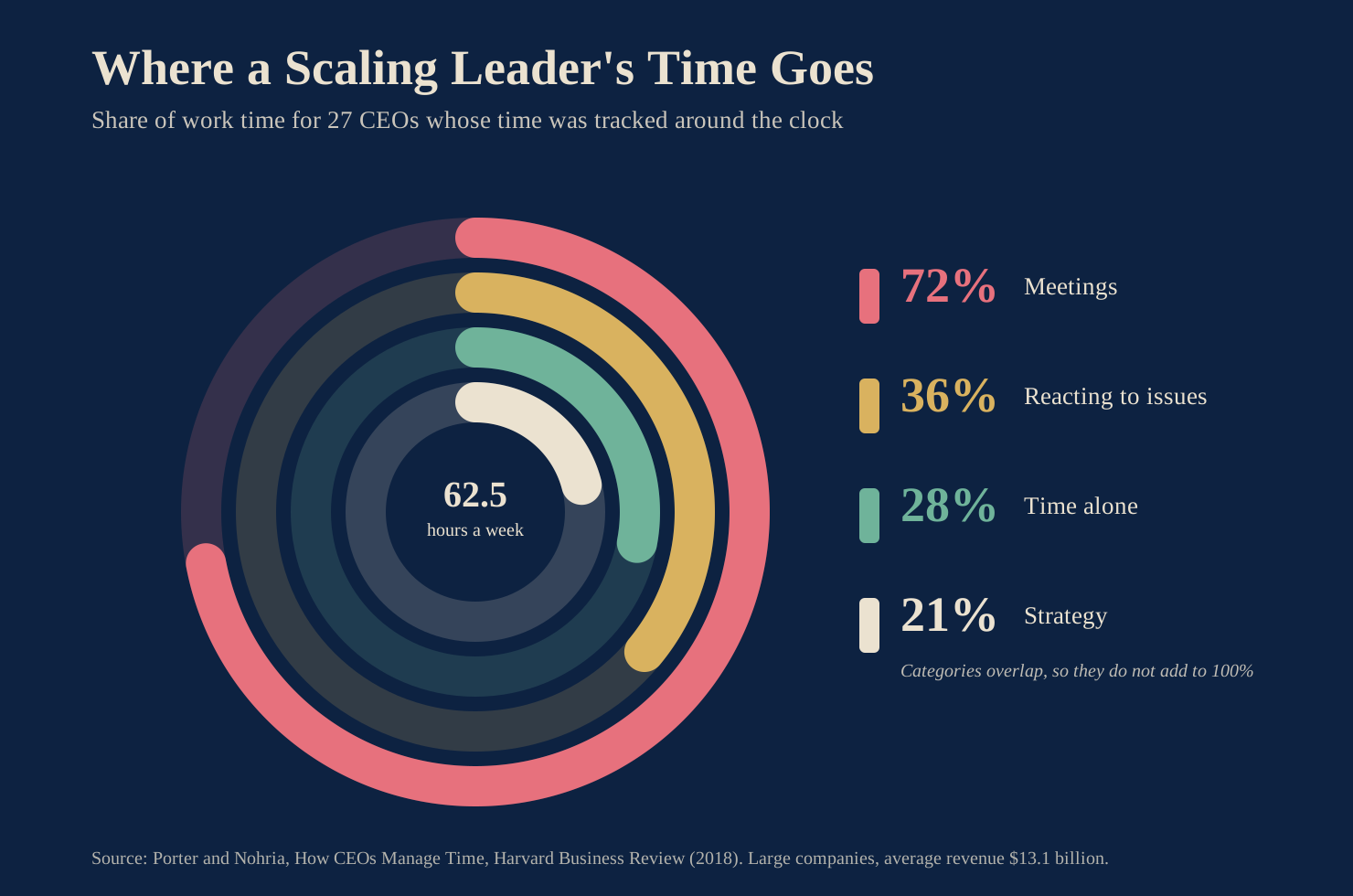
Harvard professors Michael Porter and Nitin Nohria tracked the time of 27 CEOs around the clock. The leaders worked an average of 62.5 hours a week and spent 72% of work time in meetings. Yet they still protected 28% of their work time for working alone, and 21% went to strategy. About 36% went to reacting to issues as they came up.
These were leaders of very large companies, with average revenue of $13.1 billion, so the details will not match a small business. The lesson does: even the busiest leaders block time for thinking on purpose. For a small business owner, that usually means handing off the inbox and calendar that eat those hours. Inbox and calendar support is what executive assistant services are built around.
Shift 3: From holding every decision to setting decision rules
Owners who stay small tend to approve everything. Owners who scale decide which decisions they keep and write rules for the rest: discounts up to an agreed amount, refunds under a set value, which client requests the team handles alone. Every rule removes a reason for someone to wait for you. If work keeps queuing behind you, the hidden cost of being the bottleneck in your business explains what that wait is really costing.
Shift 4: From hiring at breaking point to hiring just ahead
Most owners bring in help only when they are already overwhelmed, which means there is no time to train anyone properly. Owners who scale add support slightly before they need it, starting small and growing the role as the work grows. Often the first step is not a full-time hire at all but a few hours of flexible support. This breakdown of a staffing problem versus a capacity problem explains why the answer is not always another employee.
Shift 5: From running on gut feel to watching a few numbers
Scaling owners do not track everything. They track a handful of numbers every week, such as new leads, conversion rate, cash on hand, delivery time and customer satisfaction, and they review them at the same time each week. The Stanford research above counted monitoring and clear targets among the practices that separated more productive plants from less productive ones.
Shift 6: From owner-dependent to owner-optional
The final shift is the test of all the others: could the business run for a week without you? Not forever, and not without problems, but without stopping. Porter and Nohria found the CEOs in their study still worked on 70% of their vacation days, which shows how hard this shift is even at the top. For a small business, the goal is simpler: a week where nothing waits for your return.
The scaling maturity map: where are you now?
Use this table to place yourself on each shift. Most owners find they are at different stages on different shifts, which is normal.
| Shift | Surviving | Stabilizing | Scaling |
|---|---|---|---|
| Doing vs designing | You do the core work | Some processes are written down | Most recurring work runs on checklists |
| Time | Days are fully reactive | You block time sometimes | Strategy time is protected weekly |
| Decisions | You approve everything | A few rules exist | Clear rules, you keep only key calls |
| Hiring | Help comes at breaking point | Help comes when it hurts | Help comes just ahead of need |
| Numbers | Gut feel | Monthly review | A weekly scorecard |
| Dependence | Business stops without you | It slows without you | It runs for a week without you |
How to start making the shifts
- Score yourself on the maturity map, one row at a time.
- Pick the shift that frees the most hours. For most owners, that is shift 2 or shift 3.
- Make one change this month, such as protecting two mornings a week or writing five decision rules.
- Hand over the routine work that is filling the time you want back.
- Review the map every quarter and move to the next shift.
One shift a quarter is a realistic pace. Trying to change everything at once is how owners end up back where they started. For a broader look at why letting go drives growth, see why delegation is the bridge between survival and scale.
When not to scale yet
- Your offer is still changing month to month and has no repeatable process yet.
- Cash flow cannot support even a small amount of added cost.
- You have not yet found a customer group that buys reliably.
- Growth would stretch quality past the point clients notice.
Scaling a business that is not ready usually multiplies its problems. Stabilize first, then scale. If burnout is already a risk, this guide on how to scale without burning out is a good companion read.
Frequently asked questions
What do successful business owners do differently?
They change their role as the business grows. They design systems instead of doing every task, protect time for strategy, set rules for routine decisions, bring in help before they are overwhelmed, track a few key numbers and build a business that can run without them.
What is the biggest mindset shift when scaling a business?
Moving from doer to designer. Instead of being the person who does the work, the owner becomes the person who builds the systems, rules and team that do the work.
How do I know if my business is ready to scale?
Look for a repeatable offer, steady demand, cash flow that can support added cost and processes that can be written down. If those are in place, the main limit on growth is usually the owner’s time.
How do business owners free up time to grow?
By protecting fixed blocks for strategy, setting decision rules so fewer things wait on them and handing routine work like inbox, scheduling and follow-ups to someone else.
How many businesses survive long enough to scale?
According to the Bureau of Labor Statistics, about half of U.S. private-sector establishments opened in 2013 were still operating after five years, and about a third after ten years.
Do I need to hire full-time staff to scale?
Not always. Many owners start with flexible part-time support for routine work and add roles as the business grows. Hiring slightly ahead of need, rather than at breaking point, matters more than the type of hire.
What to do next
Place yourself on the maturity map today. Pick the one shift that would free the most hours and make a single change this month. That is what successful business owners do differently: they change one thing at a time.
Expansion Desk matches business owners with vetted, trained assistants, with a dedicated onboarding support team behind them. See how a virtual assistant for small business can take routine work off your plate so you can focus on the shifts that grow the business.
Aiming to scale this year? Book a free discovery call and bring your maturity map.
Sources
- U.S. Bureau of Labor Statistics, 34.7 Percent of Business Establishments Born in 2013 Were Still Operating in 2023, The Economics Daily (2024). bls.gov
- Stanford Graduate School of Business, How Much Does Management Matter for Productivity? (Bloom and colleagues). gsb.stanford.edu
- Porter and Nohria, How CEOs Manage Time, Harvard Business Review (2018), as reported by CNBC and MGMA. cnbc.com

- How to Do a Time Audit as a Business Owner (Free Template) - November 11, 2026
- Everyone Is Talking About AI Taking Over Small Business, Here Is What Is Actually True - November 4, 2026
- What Successful Business Owners Do Differently When They Scale - November 4, 2026