

It is 9:40 on a Tuesday night. The last client email is finally sent, but the CRM still needs updating, two invoices have not gone out, and a lead from Friday is still waiting for a reply. None of it is difficult. It just keeps landing on you.
That is the real problem inside most small businesses: too much of the wrong kind of work sitting with one person. It is also why more owners now talk to a virtual assistant agency before they burn out, not after.
Here is what the data says, what a virtual assistant actually solves, and how to decide if this is the year it makes sense.
Executive summary
- Owners work more than they want to. In a Business Pulse Survey by The Alternative Board, owners averaged 49.4 hours a week against an ideal of 41.7, and 63% worked more than 50.
- Most of that time goes into running the business, not growing it. The same survey found owners spend about 32% of their time on strategic work, while 73% would prefer to be doing it.
- A traditional hire costs more than the salary. Benefits make up 30% of private industry employer compensation costs (BLS, June 2026), and SHRM puts the average cost per non-executive hire at $5,475.
- Why companies outsource has changed. Deloitte reports that cost is no longer the dominant reason. Access to skills and keeping up with customers now matter just as much.
- A virtual assistant is not a fix for everything. It works best for recurring tasks you are willing to hand over properly.
Is hiring a virtual assistant worth it?
Hiring a virtual assistant is worth it when recurring tasks are taking time you should be spending on sales, clients or strategy. For most small businesses, the biggest cost is not the assistant. It is the owner’s hours going into inbox management, scheduling, data entry and follow-up that someone else could handle just as well.
The Alternative Board (TAB), a US peer advisory network, asked owners how they spend their week.
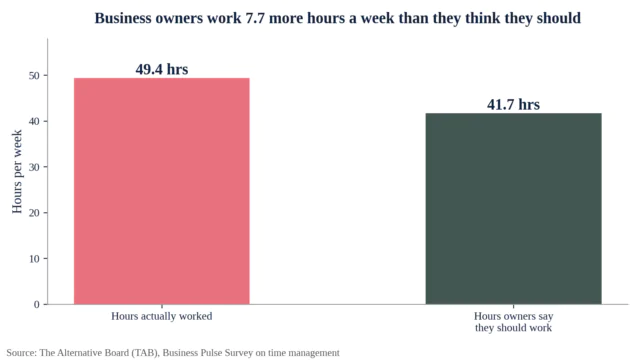
Owners in the survey averaged 49.4 hours a week, while saying they should be working 41.7. Administrative work was the second most common time waster they named. A separate TAB productivity survey found the average owner gets only about 1.5 hours of uninterrupted, high-quality work time a day.
These surveys are several years old, but the pattern still holds. Nearly eight extra hours a week is a full working day, every week, and it rarely goes to the work that grows revenue.
Why “I will just hire someone full-time” is not always the answer
When the workload gets heavy, the instinct is to hire an employee. Sometimes that is right, but know what the decision involves first.
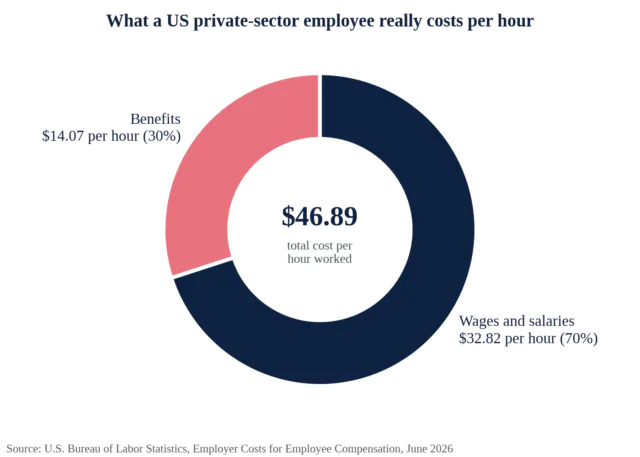
According to the U.S. Bureau of Labor Statistics, private industry employers spent an average of $46.89 per hour worked in June 2026. Only $32.82 of that was wages. The remaining $14.07, or 30%, went to benefits such as paid leave, insurance and legally required contributions.
Then there is the cost of hiring itself. SHRM’s 2025 Benchmarking Report puts the average cost per non-executive hire at $5,475, and median time to fill a role at roughly a month and a half. That is six weeks where the work still sits with you.
None of this means employees are poor value. It means a full-time hire is a large, slow commitment. If the work does not yet fill a full week, or you are not sure what the role should look like, a flexible support model lets you find out first. If you are weighing the options side by side, this breakdown of virtual assistant vs in-house hire vs freelancer covers cost, speed and oversight.
What has changed in 2026
For years, outsourcing was sold almost entirely on cost. That is changing.
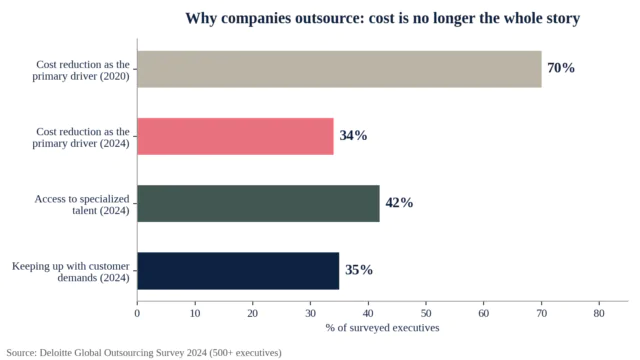
Deloitte’s 2024 Global Outsourcing Survey of more than 500 executives found that 80% plan to maintain or increase their investment in outsourcing, and half now outsource front-office work like sales and marketing, not just back-office tasks. Cost as the primary driver has fallen sharply since 2020, while access to skilled talent has taken its place.
These are large companies, but the lesson carries over: businesses outsource for capacity and skills, not only savings.
AI adds a new layer. The same survey found 83% of executives already use AI within their outsourced services. For a small business, that is a useful reminder: AI can draft the email, summarize the call or tidy the spreadsheet, but someone still has to check it, send it and own the result. That ownership is where a good assistant earns their place, and it is the core difference between AI agents and virtual assistants for a small business.
5 signs your business is ready for a virtual assistant
- The same tasks come back every week. Scheduling, inbox triage, CRM updates and reporting repeat on a cycle.
- People are waiting on you. Leads, clients or your own team regularly sit in a queue because a reply depends on you.
- You could explain the task in a checklist. If a short document or screen recording would cover it, it does not need you.
- Admin happens at night and on weekends. When routine work only fits outside business hours, your capacity is already full.
- Growth work keeps getting postponed. Sales calls and partnerships stay on next week’s list.
If three or more of these sound familiar, the question is probably not whether to get help, but which work to hand over first. For a longer self-check, go through these 12 signs it is time to build a delegation system.
What to delegate first
Start with work that is frequent, low risk and easy to check.
| Task | Why it drains owner time | Delegation fit |
|---|---|---|
| Inbox and calendar management | Constant small interruptions that break focus | High |
| CRM updates and lead follow-up | First thing to slip when you are busy | High |
| Social media scheduling and replies | Inconsistent without a clear owner | High |
| Bookkeeping data entry and invoicing | Piles up until month end | Medium to high, with access controls |
| Patient scheduling and records admin | High volume, time sensitive | Medium to high, with HIPAA-aware processes |
| Pricing, key client relationships, hiring | Needs your judgment and authority | Keep with the owner |
For most owners, inbox and calendar are the easiest first handover because the results are visible within days. That is exactly the kind of work executive assistant services are built around. Specialist roles, such as bookkeeping or social media support, make more sense once the basics are running smoothly.
What this looks like in practice
The example below is a hypothetical scenario to illustrate the process. It is not a real client.
Maria runs a three-person marketing consultancy. She tracks her week and finds the same pattern every Monday: an overflowing inbox, meeting requests going back and forth, and new leads sitting in the CRM without a first reply.
She starts small. In week one, her assistant takes over calendar booking and sorts the inbox into “needs Maria” and “handled.” In week two, they add a lead follow-up template and a daily CRM update. By the end of the first month, Maria is reviewing work instead of doing it, and her Monday mornings go back to client strategy.
When a virtual assistant is not the right move
A virtual assistant is probably not the right fit yet if:
- Your tasks change every day with no repeatable pattern.
- You cannot set aside any time in the first few weeks to explain how things work.
- The work genuinely requires someone on site.
- What you really need is a senior decision-maker, not support.
- Your processes live only in your head and you are not ready to write them down.
In those cases, fix the process first.
How to hire a virtual assistant without it backfiring
- Track one normal week. Write down every task and roughly how long it took.
- Pick three to five recurring tasks. Choose work that is frequent, low risk and easy to check.
- Document each task once. A short checklist or screen recording is usually enough.
- Set up access safely. Use a password manager and role-based permissions instead of sharing your own logins.
- Agree on a 30-day starting scope. Hold a short weekly check-in and adjust as you go.
- Expand once quality is consistent. Add responsibilities only after the first tasks run without you.
Frequently asked questions
Is hiring a virtual assistant worth it for a small business?
Yes, when recurring tasks are taking time you should spend on revenue-producing work. The value comes from giving your hours back to sales, clients and strategy, not only from the cost of the support itself.
What tasks should I give a virtual assistant first?
Start with frequent, low-risk, easy-to-check work: inbox triage, calendar management, CRM updates, lead follow-up and social media scheduling. Keep pricing, key relationships and hiring decisions with you.
Is my business too small for a virtual assistant?
Usually not. Size matters less than repetition. A solo consultant with five hours of weekly admin can benefit more than a larger team with no clear tasks to hand over.
Will AI replace virtual assistants?
AI is changing the job rather than removing it. AI can speed up drafting, research and data work, but a person still needs to check the output, handle exceptions and take responsibility for getting it done.
What is the difference between a virtual assistant and a freelancer?
A virtual assistant provides ongoing support across recurring tasks, often as part of your daily workflow. A freelancer is usually hired for a defined project or deliverable. If the work repeats every week, a virtual assistant is typically the better fit.
Is it safe to give a virtual assistant access to my business accounts?
It can be, if access is set up properly. Use a password manager to share logins without revealing passwords, give role-based permissions instead of full admin rights, and remove access immediately when the engagement ends.
How long does it take a virtual assistant to get up to speed?
It depends mostly on your documentation. Simple, well-documented tasks like calendar management can be handed over quickly, while work that relies on your judgment takes longer. Starting with three to five clearly written tasks shortens the learning curve.
What to do next
Start with the one-week task audit. Repeatable work that does not need you is your signal.
Expansion Desk helps small businesses hand off recurring administrative and operational work without adding a full-time employee straight away. See how a virtual assistant for small business can take that work off your plate.
Not sure where to start? Book a free discovery call and talk through which tasks to delegate first.
Sources
- The Alternative Board (TAB), Business Pulse Survey: Time Management and Business Owners. thealternativeboard.com/time-management
- The Alternative Board (TAB), Business Pulse Survey: Business Leaders and Productivity. thealternativeboard.com/pulse-survey-business-leaders-productivity
- U.S. Bureau of Labor Statistics, Employer Costs for Employee Compensation, June 2026 (released September 9, 2026). bls.gov/news.release/ecec.nr0.htm
- SHRM, The State of Recruiting 2025 and 2025 SHRM Benchmarking Report. shrm.org
- Deloitte, Global Outsourcing Survey 2024. deloitte.com

- What Nobody Tells You Before You Hire Your First Virtual Assistant - October 5, 2026
- 5 Signs You Are the Bottleneck in Your Own Business - October 1, 2026
- The One Task Costing You the Most Time Every Week (and How to Fix It) - September 30, 2026