

You hand off a task on Monday. By Wednesday it comes back half done, or done in a way you would never have chosen. You fix it yourself and quietly decide that delegating does not work for you. Before you decide that, ask one honest question: am I ready to delegate?
Most of the time, the person you handed it to was not the problem. The handover was. Before you bring in a team member or a virtual assistant provider, it is worth asking a different question: not whether the business needs help, but whether you are ready to give it away.
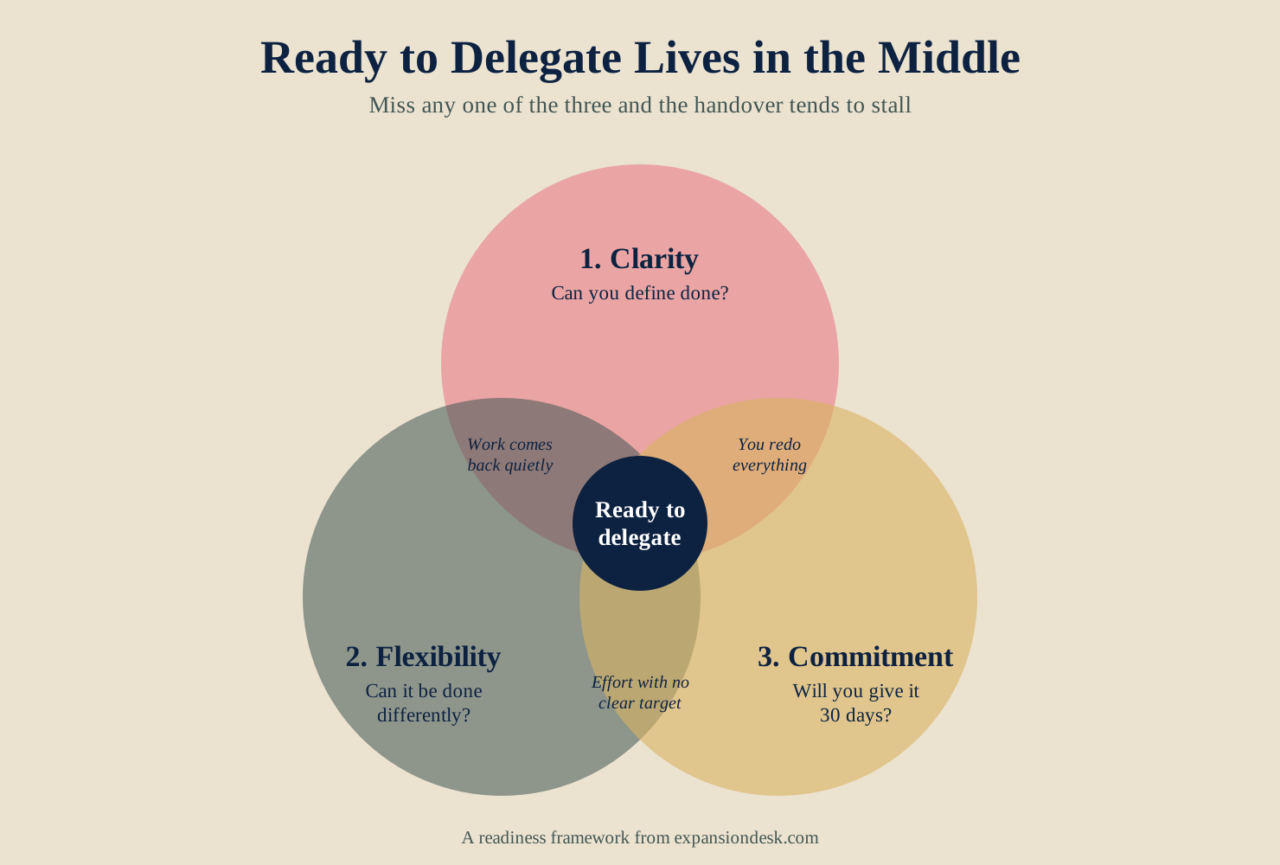
Three questions answer that. Each one takes less than a minute, and each one points to a fix you can make this week.
Need vs readiness: why being ready to delegate is different
Being ready to delegate means you can define the result, accept a different route to it and commit time to the first month. Needing help is about workload. Being ready is about you. A business can badly need help while its owner is not yet ready to hand anything over, and that gap is where most failed handovers start.
If you are still unsure whether you need help at all, start with these 12 signs it is time to build a delegation system. This article picks up where that one ends: you have the need, but are you set up to succeed?
Question 1: Can you describe what done looks like in two sentences?
Why it matters: people cannot hit a target they cannot see. Gallup reported that just under half of U.S. employees strongly agreed they knew what was expected of them at work in late 2024, down from 56% in early 2020. If clarity is that hard inside established companies, it is harder still when the rules live only in an owner’s head.
“Handle my inbox” is a task. “Every client email answered within one business day, anything about pricing flagged to me” is a definition of done. The second version can be checked, taught and improved. The first leads to guesswork.
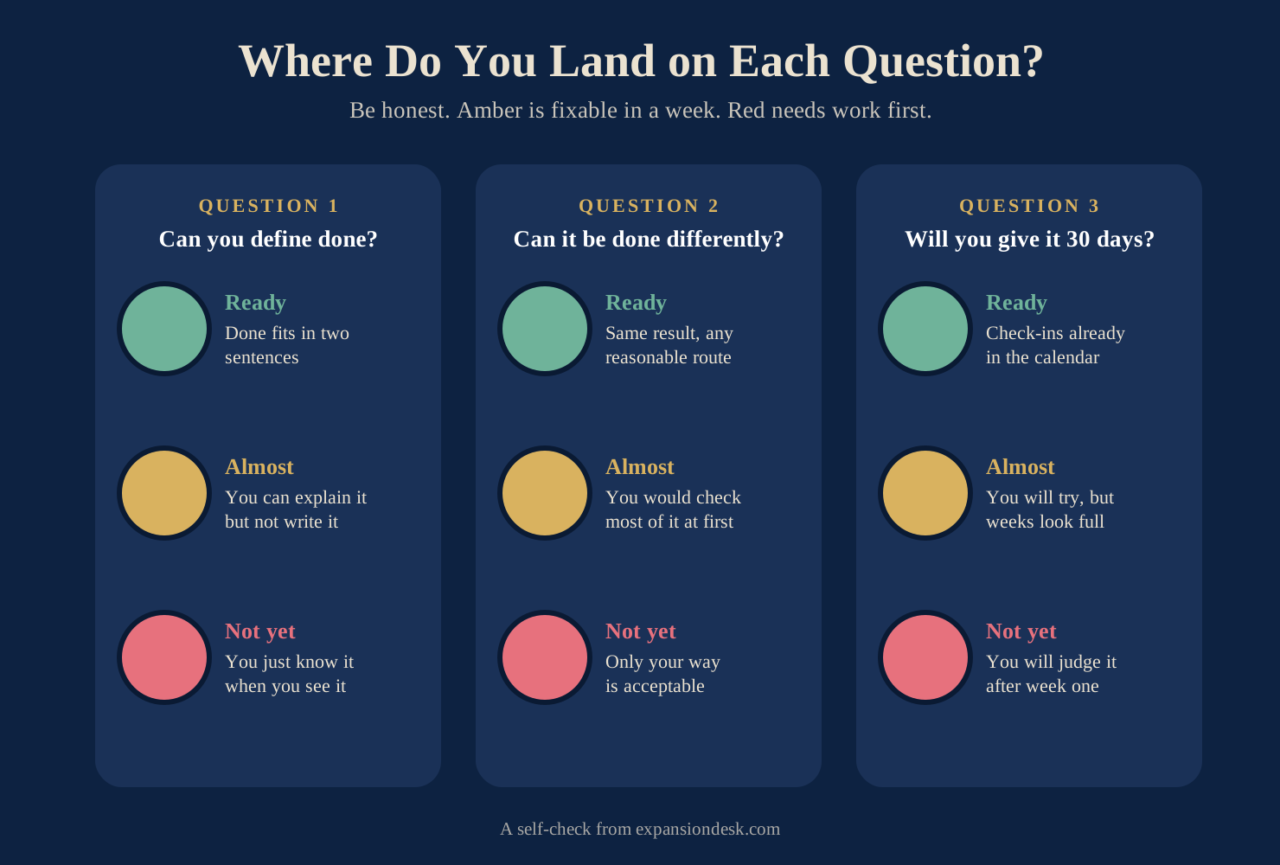
- You are ready if you can write the result in two sentences that someone new could follow.
- You are almost there if you can explain it out loud but have never written it down.
- You are not ready yet if your honest answer is “I’ll know it when I see it.”
Get ready this week: pick one recurring task and write two sentences: what the finished result is, and when it is due. If you cannot, the task is not ready to leave your desk yet.
Question 2: Can you accept it being done differently, as long as the result is right?
Why it matters: we tend to rate our own way of doing things more highly than it deserves. In a study led by Stanford’s Jeffrey Pfeffer with Robert Cialdini, 282 MBA students played managers overseeing an advertising task. The more involved and in control they felt, the better they rated the final work, a pattern the researchers called self-enhancement bias. Even outside observers rated work higher when they believed it had been closely supervised.
The lesson is uncomfortable but useful: some of your sense that “nobody does it as well as me” is a bias, not a fact. If every deviation from your method feels like a mistake, you will end up redoing the work, and the handover will fail no matter who you hire.
- You are ready if a different route to the same result is fine with you.
- You are almost there if you would want to check most of the work at first.
- You are not ready yet if only your exact method is acceptable.
Get ready this week: for one task, list what must not change (the result, deadlines, tone with clients) and what can change (order of steps, tools, wording). Everything on the second list is room for someone else to work their way.
Question 3: Will you give it 30 days of attention before judging it?
Why it matters: setting someone up well feels slower and less satisfying than doing the work yourself. MIT Sloan senior lecturer Elsbeth Johnson, writing in Harvard Business Review in 2025, describes how many leaders believe that real work is hands-on activity, which makes the context-setting part of delegation feel like a distraction rather than the job.
That belief is what makes owners give up in week one. The first two weeks of any handover involve explaining, checking and correcting. The payoff usually comes after that, once the person has seen enough examples to work without you.
- You are ready if short check-ins are already in your calendar for the next month.
- You are almost there if you plan to try but your weeks already look full.
- You are not ready yet if you expect to know whether it works after a few days.
Get ready this week: block 15 minutes a day for the first two weeks and 30 minutes a week after that. Set a review date 30 days out and do not judge the handover before it.
Where do you land: are you ready to delegate?
| Your answers | What it means | What to do next |
|---|---|---|
| Green on all three | You are ready to delegate | Hand over two recurring tasks this month |
| Any amber, no red | Ready for a small trial | Start with one task and fix the amber first |
| Any red | Not ready yet, and that is fixable | Work on the red question for two weeks, then ask again |
Most owners land somewhere in the middle, and that is normal. Amber answers usually take a week to fix. Red answers take a little longer, but none of them require you to become a different person, only to change how you hand work over.
Turn your answers into a one-page brief

Once you can answer all three questions, put the answers on one page. A delegation brief turns readiness into something the other person can actually use:
- Task: what is being handed over.
- Done looks like: your answer to question 1.
- You can decide: the freedom from question 2.
- Check with me: the limits that always come back to you.
- Examples: two or three past results you were happy with.
- Check-in: the rhythm from question 3.
One brief per task is enough. Over time, these pages become the documented processes that let the business run without you, which is the real point of delegating. If a lack of written processes keeps you stuck, the hidden cost of being the bottleneck in your business explains what it costs to stay there.
The same task, handed over two ways
| Not ready | Ready | |
|---|---|---|
| The request | “Can you look after my inbox?” | “Reply to client emails within one business day. Flag pricing and complaints to me.” |
| The method | Owner expects it done exactly as they would | Owner fixes the result, leaves the route open |
| The first month | Owner checks in once, then gives up | 15-minute check-ins daily, review at day 30 |
| The outcome | Task comes back to the owner | Task stays handed over |
Ready to delegate? When you should still hold back
- The task needs your judgment every time, such as pricing or key client relationships.
- The task happens once and will not repeat.
- Mistakes would be serious and hard to undo, unless you start with drafts only.
Readiness is about you. These limits are about the task. You need both to line up.
Frequently asked questions
How do I know if I am ready to delegate?
Ask three questions. Can you describe what done looks like in two sentences? Can you accept it being done differently if the result is right? Will you give it 30 days of attention before judging it? Three yes answers mean you are ready.
Why do so many business owners struggle to delegate?
Often because results are not clearly defined, because people overvalue work they control closely, and because setting someone up feels less productive than doing the task. Stanford research on self-enhancement bias found people rate work more highly when they feel more involved in it.
What is the difference between needing help and being ready to delegate?
Needing help is about workload: too many recurring tasks for one person. Being ready is about the owner: clear expectations, room for a different method and time to set someone up properly.
What should I delegate first once I am ready?
Start with recurring, rule-based tasks that are easy to check, such as inbox triage, scheduling and follow-ups. Inbox and calendar support is often the simplest first handover.
How long does it take for delegation to start working?
Plan for about 30 days. The first two weeks usually involve explaining and correcting, and the time savings tend to show up once the person has enough examples to work on their own.
What is a delegation brief?
A one-page summary of a task: what it is, what done looks like, what the person can decide, what must come back to you, examples of good results and how often you will check in.
What to do next if you are ready to delegate
Answer the three questions about one task, today. If you land green, write the brief. If you land amber or red, fix that one question this week, then ask again. For the bigger picture of why this matters, see why delegation is the bridge between survival and scale.
When you are ready, Expansion Desk matches business owners with vetted, trained assistants, with a dedicated onboarding support team behind them. Inbox, calendar and day-to-day coordination are the heart of our executive assistant services, and a natural first brief to write.
Green on all three? Book a free discovery call and bring your first delegation brief.
Sources
- Stanford Graduate School of Business, Why Some Managers Won’t Let Go (Pfeffer, Cialdini, Knopoff and Hanna). gsb.stanford.edu
- Fortune, Half of Employees Feel Lost at Work (Gallup data, November 2024). fortune.com
- MIT Sloan Executive Education, The Delegation Dilemma: Why Leaders Struggle to Let Go (Elsbeth Johnson, citing Harvard Business Review, 2025). executive.mit.edu

- How to Do a Time Audit as a Business Owner (Free Template) - November 11, 2026
- Everyone Is Talking About AI Taking Over Small Business, Here Is What Is Actually True - November 4, 2026
- What Successful Business Owners Do Differently When They Scale - November 4, 2026