

Most founders do not decide to burn out. It happens gradually, in the space between a growing task list and a calendar that never gets any lighter. One quarter you are closing deals and setting direction. A few months later you are still doing that, plus formatting invoices and chasing follow-up emails, wondering why the work that would actually grow the business keeps sliding into next week. The shift rarely feels dramatic. It just feels like being busy, until it does not.
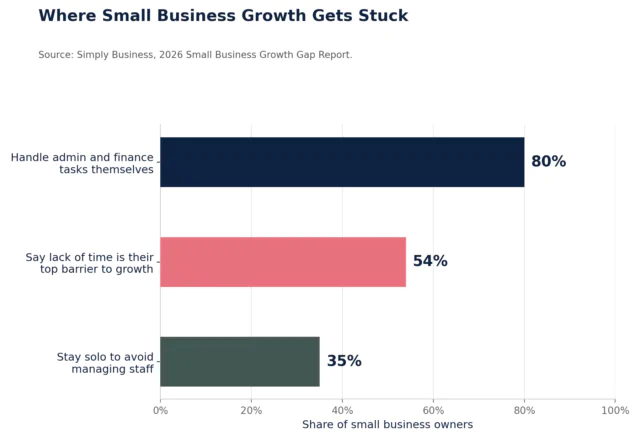
The numbers back up what that feeling is telling you. In Simply Business’s 2026 Small Business Growth Gap Report, 80 percent of small business owners said they still handle their own administrative and finance work, and 54 percent named a lack of time, not a lack of opportunity, as the single biggest barrier standing between them and their next stage of growth. The twelve signs below are a way to check where you actually stand right now, before deciding whether bringing in virtual assistant support is the right next step for your business.
Your Calendar Runs You, Not the Other Way Around
The first pattern shows up in your schedule long before it shows up anywhere else.
- Your day fills up before you have opened your laptop, and the blocks of uninterrupted thinking time you used to protect on purpose are simply gone.
- Meetings get added because someone asked, not because they belong on this week’s actual priority list.
- The kind of work a general virtual assistant is built to own, confirming an appointment, cleaning up a document, sending a follow-up note, still lands on your desk before it lands on anyone else’s.
- Hours that used to be off limits, evenings, weekends, the first hour of your morning, have quietly turned into unpaid overtime, and it no longer feels unusual.
The Business Cannot Move Without You
The second pattern has less to do with your time and more to do with how much of the business runs through you personally.
- Decisions sit untouched until you weigh in, even ones your team has handled correctly before without you.
- Customers and colleagues come to you first by habit, not because it needs your judgment, but because no executive assistant is in place to catch it first.
- A real break, the kind where you are not checking messages between meals, is something you plan for and then quietly cancel.
- A handful of processes only make sense inside your head, so the business slows down slightly every time you are unreachable.
Growth Has Gone Quiet
The third pattern is usually the one founders notice last, because on any given day it does not feel like a problem. It just feels like being busy.
- Revenue has leveled off, not because interest dried up, but because marketing outreach takes time nobody currently has.
- Ideas for a new offer, a campaign, or a partnership worth exploring sit in a notes app, sometimes for months, waiting on a version of you with more hours in the day.
- A hire that would genuinely lighten the load keeps getting pushed to a quieter quarter, one that never actually arrives.
- Somewhere along the way, a good week started meaning nothing broke, instead of meaning something moved forward.
Two or three of these will describe almost any founder in a busy stretch. Most of them describing your current week is a different signal, and it is worth taking seriously.
Quick Self-Check
Go through the list once, honestly, and count how many apply to your week right now.
Applies?
Not sure where you stand? A 20 minute consult will tell you exactly what to hand off first.
| Score | What it means |
| 0 to 3 signs | You are managing well. Keep an eye on it as you grow. |
| 4 to 7 signs | You are at the tipping point. Delegate one function this quarter. |
| 8 to 12 signs | You have hit the breaking point. A delegation system is overdue. |
What These Signs Actually Point To
Each cluster above points to a different kind of gap, and closing it does not require rebuilding your whole business at once.
- Calendar and inbox overload is usually solved by handing off the operational layer entirely, scheduling, inbox triage, meeting prep, to one person who owns it as their actual job, not as something squeezed between yours. This is the role most people picture as a general virtual assistant.
- A sign-off bottleneck almost always means a process was never written down, not that your team is incapable of running it. Documenting it once and handing the follow-through to a dedicated executive assistant or day-to-day operations lead removes you from the loop for good.
- A stalled revenue line usually means outreach, follow-up, and lead qualification quietly stopped happening, because nobody had time left to own that motion. Dedicated marketing support exists specifically to keep it moving without you.
- Ideas that never ship are typically a production problem, not a strategy problem. Handing execution work, web updates, content, and search visibility to specialists like a web developer or SEO specialist tends to unstick a backlog faster than another planning session ever will.
How to Start Building One
None of this requires an overhaul in one weekend. It requires picking a starting point and actually following through.
- Pick one recurring task, not everything at once. The clearest candidates are the ones that show up on your calendar every week but rarely require your judgment.
- Write down how you currently do it, even roughly. That becomes the first process document someone else can follow without you.
- Ask whether the task needs your judgment or just your time. If the honest answer is time, it is ready to hand off.
- Set a trial period of two to four weeks. Judge it by whether it freed you up, not whether it matched exactly how you would have done it.
- Revisit the list monthly. New signs will surface as the business grows, and that is a mark of progress, not a setback.
Frequently Asked Questions
How many of these signs mean I need to change something?
There is no exact number, but four or more from this list generally means at least one task is ready to hand off. Eight or more suggests the business has already outgrown what one person can manage alone.
What should get delegated first?
Start with whatever task shows up most often on your calendar while requiring the least of your personal judgment, usually scheduling, inbox management, or routine follow-up. It tends to be the fastest win and the easiest one to measure.
Isn’t it faster to just keep doing it myself?
In the moment, yes. Over a month, rarely. A fifteen-minute task done daily adds up to more than seven hours a month, time that could go toward work only you can do.
How is a virtual assistant different from hiring an employee?
A virtual assistant is matched to a specific role and a set number of hours, without the cost of a full salary, benefits, or office space. The arrangement can scale up, scale down, or end far more easily than a traditional hire.
What if I genuinely do not know what to hand off yet?
That is common, and it is exactly what the self-check above is for. Most founders find their first one or two tasks simply by counting which signs they checked most often.
Ready to Hand Something Off?
If several of these signs sound familiar, the fastest path forward is usually delegating one function well, not restructuring everything at once. ExpansionDesk helps USA based businesses hire vetted virtual assistants across nine specialized roles, matched in days rather than months and backed by a 90 day replacement guarantee. Explore ExpansionDesk’s virtual assistant services or hire your first virtual assistant today once you know which task to hand off.