

It is Sunday evening and you are clearing the inbox so Monday feels lighter. It never does. You keep working longer hours, 60 of them last week, and revenue looks exactly like it did three months ago.
Most owners were taught that effort is the engine of growth. Up to a point, it is. Past that point, extra hours buy less and less, which is why so many owners eventually talk to a virtual assistant agency instead of adding another late night.
This article looks at what the research says about long hours, why they stop producing growth and what owners who scale do with their time instead.
Executive summary
- Working longer hours stops paying off around 50 a week. Stanford economist John Pencavel found output rises in step with hours up to roughly 49, then flattens. In his data, 70 hours produced little more than 55.
- The extra hours are usually admin, not growth. Microsoft’s 2025 data shows 40% of workers online by 6 a.m. checking email and meetings after 8 p.m. up 16% year on year.
- Long hours cost owners personally. A 2026 Patriot Software survey found 84.6% of small business owners have made a significant sacrifice in health, sleep or relationships for the business.
- Growth comes from leverage, not effort. Systems, delegation and protected time for sales and strategy move the business forward. Extra hours mostly keep it running.
- The fix starts with an honest look at where your hours go. A simple growth-hours test shows how much of your week actually builds the business.
Does working longer hours grow your business?
Working longer hours keeps a business running, but it rarely makes it grow. Beyond about 50 hours a week, research shows output per hour falls sharply, and the extra time usually goes to email, admin and catch-up work. Growth comes from spending more of your existing hours on sales, clients and strategy, and handing routine work to someone else.
What the research says about working longer hours
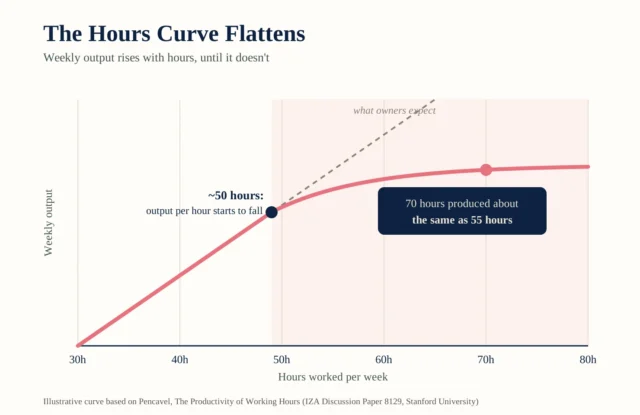
John Pencavel of Stanford University studied detailed records of munitions workers and found a clear pattern. Up to about 49 hours a week, output grew roughly in proportion to hours. Beyond that, each extra hour added less, and at 70 hours, total output was barely higher than at 55.
The data is historical and comes from factory work, not small business ownership. But the mechanism is familiar to anyone who has run a business through a busy season: fatigue builds, mistakes rise and simple tasks take longer. The last 15 hours of a 70-hour week are often the least valuable hours you work.
Where the time goes when you keep working longer hours
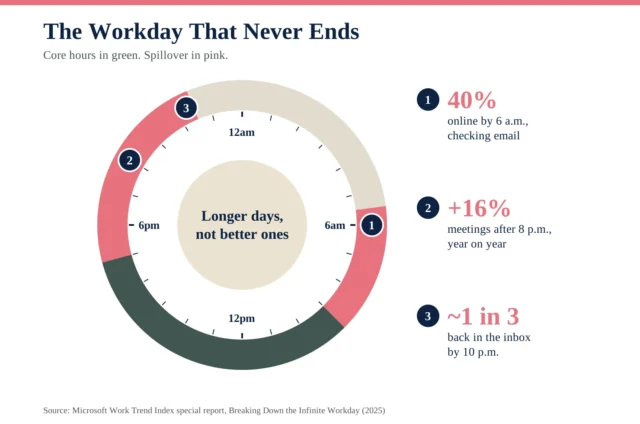
Microsoft’s 2025 research on the “infinite workday” found 40% of workers online by 6 a.m. reviewing email, meetings after 8 p.m. up 16% year on year and nearly a third of active workers back in their inbox by 10 p.m.
For an owner, those early and late hours are rarely spent on new clients or new offers. They go to replying, scheduling, invoicing and fixing small problems. The day gets longer, but the share of it spent on growth stays the same or shrinks. Most of that work sits on the list of tasks small business owners should delegate first.
If that pattern sounds familiar, it is the same trap described in the hidden cost of being the bottleneck in your business: every routine task that needs you adds hours without adding progress.
Busy work vs growth work
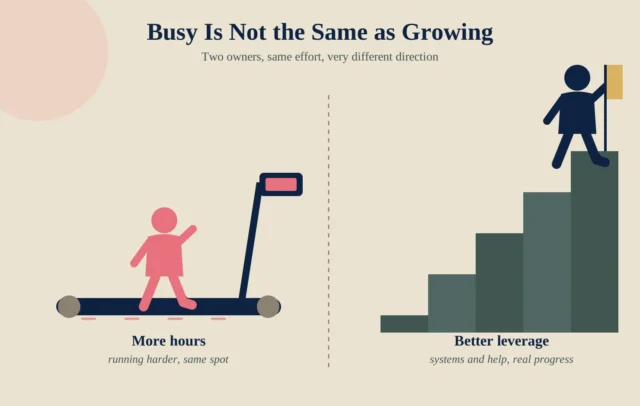
The difference is not effort. It is direction. Busy work keeps the lights on. Growth work changes what the business can earn next quarter.
| Busy work | Growth work | |
|---|---|---|
| Examples | Inbox, scheduling, data entry, invoice reminders, routine questions | Sales calls, key client relationships, pricing, new offers, partnerships, hiring |
| What it does | Keeps the business running today | Changes what the business earns next quarter |
| Needs the owner? | Rarely, once rules are written down | Usually, at least at first |
| What happens if you add hours | More gets done, nothing changes | Real progress, if the hours are protected |
Most owners do not lack growth work. They lack uninterrupted time to do it, because busy work fills every gap first, and working longer hours only gives it more room.
Why owners keep working longer hours anyway
- It worked at the start. In the early days, extra effort directly produced more sales. The habit stays long after the math changes.
- Busy feels productive. Clearing 40 emails feels like progress, even when none of them moved the business forward.
- Handing work over feels slower. Explaining a task takes longer than doing it once, so owners keep doing it forever.
- There is no one else. Without support, every task defaults to the owner, and longer hours become the only release valve.
The cost is real. Patriot Software’s 2026 survey of 1,000 small business owners and managers found 84.6% have made a significant personal sacrifice for their business, such as health, sleep or relationships. Tired owners also make slower, worse decisions, which quietly costs the business too.
The growth-hours test
Here is a simple way to see whether your hours are building the business. Track one normal week, then sort every block of time into one of three groups.
- Growth hours: sales, key clients, pricing, new offers, hiring and strategy.
- Delivery hours: doing the core work clients pay for.
- Admin hours: email, scheduling, invoicing, data entry, posting and follow-ups.
Then compare growth hours to total hours. If fewer than one in five of your hours go to growth, working longer hours will not change much. Moving admin hours off your plate will.
This is an Expansion Desk framework, not a research benchmark, so treat the one-in-five line as a starting point rather than a rule. What matters is the trend: if your total hours go up while growth hours stay flat, you are on the treadmill.
What owners who scale do instead of working longer hours
1. They protect growth time first
They block sales and strategy time in the calendar before the week fills up, and treat it like a client meeting. Admin fits around it, not the other way round.
2. They build systems instead of extra hours
Checklists, templates and written rules turn recurring work into something anyone can do. If you have not started yet, this guide on how to build a delegation system is a good place to begin.
3. They hand routine work to someone else
Inbox, calendar, scheduling and follow-ups are the first things they give away, because those tasks interrupt every hour of the day. That is the core of executive assistant services, and it is often the fastest way to win back focused time.
4. They measure output, not hours
They track proposals sent, calls booked and clients won. A week with fewer hours and more growth work is a better week, even if it feels less busy.
What this looks like in practice
The example below is a hypothetical scenario to illustrate the process. It is not a real client.
Rachel runs a small accounting practice and works about 62 hours a week. She runs the growth-hours test and finds only about 6 of those hours go to winning or growing clients. Most of the rest is client email, booking calls and chasing documents.
Instead of adding Saturdays, she hands scheduling and document collection to an assistant and blocks two mornings a week for business development. Her total hours come down a little. Her growth hours roughly double. The business is not running on more effort. It is running on better use of the effort she already gives it.
For a fuller walk-through of this kind of shift, see how one small business owner could get 15 hours a week back.
When working longer hours makes sense
Sometimes a push is the right call:
- A product launch or a major client deadline
- A seasonal peak you can plan for
- The first months of a new business, before there is anything to delegate
The test is whether the push has an end date. Long hours as a sprint can work. Long hours as a permanent operating model usually mean the business needs support, not more effort. If you are weighing that choice now, see is hiring a virtual assistant worth it.
Frequently asked questions
Does working longer hours make a business more successful?
Not beyond a point. Research by Stanford economist John Pencavel found output per hour drops sharply after about 50 hours a week. Growth depends more on how your hours are spent than on how many you work.
How many hours should a small business owner work?
There is no single right number, but research suggests productivity per hour falls beyond about 50 a week. A better question is how many of your hours go to growth work like sales, clients and strategy.
What is the difference between being busy and growing a business?
Busy work keeps the business running today: email, scheduling, admin and routine questions. Growth work changes what it can earn next: sales, key relationships, pricing and new offers.
How can I grow my business without working more hours?
Protect fixed time for growth work, build simple systems for recurring tasks and hand routine admin to someone else. Measure progress by outcomes like calls booked and clients won, not hours worked.
Is it a bad sign if I always work evenings and weekends?
It is usually a sign that routine work has no one else to go to. If evening hours go to email and admin rather than growth, that time is a good candidate to hand over.
Can a virtual assistant help me work fewer hours?
Yes, for routine, rule-based work such as inbox triage, scheduling, invoicing and follow-ups. The first few weeks take some of your time to set up, and the savings usually grow over the first few months.
What to do next instead of working longer hours
Run the growth-hours test this week. If admin is crowding out growth, the answer is not another late night of working longer hours. It is moving that work to someone else.
Expansion Desk matches business owners with vetted, trained assistants, with a dedicated onboarding support team behind them. See how a virtual assistant for small business can take routine work off your hours.
Want to turn more of your week into growth time? Book a free discovery call and bring your growth-hours numbers.
Sources
- John Pencavel, The Productivity of Working Hours, IZA Discussion Paper No. 8129 (2014). docs.iza.org
- Microsoft WorkLab, Work Trend Index Special Report: Breaking Down the Infinite Workday (2025). microsoft.com/worklab
- Patriot Software, Small Business Owner Burnout Survey (2026). patriotsoftware.com