

This article walks through a hypothetical example. Dana and her business are not a real client. The hours are realistic estimates built task by task, so you can test the same math against your own week.
Most owners guess they spend a few hours a week on admin. When they actually track it, the number is usually much higher, and it hides in five-minute replies, quick reschedules and late-night invoicing.
This is the story of how that time could come back, step by step, with a virtual assistant agency supporting the handover. No productivity hacks, just a clear audit and the right work moved to the right person. If your week feels full but you cannot say where it went, this is for you.
Executive summary
- Admin quietly takes days, not minutes. A 2026 American Express survey of 1,000 UK small business owners found they spend about 11 hours a week on admin and finance tasks, nearly twice the time they spend on sales and growth.
- Fifteen hours is realistic, not magic. In this example, it comes from six routine tasks, each saving between 2 and 4 hours a week.
- Managing help costs time too. The example includes an hour a week of check-ins, because pretending delegation is free is how expectations go wrong.
- The time comes back gradually. Most of the savings arrive over about three months, not in week one.
- The real win is where the time goes. Freed hours only matter if they move to sales, clients or rest.
How can a small business owner get 15 hours a week back?
A small business owner can get around 15 hours a week back by tracking a normal week, finding the routine admin that does not need them, and handing it to a trained assistant in stages. Inbox triage, scheduling, invoicing, bookkeeping entry, lead follow-up and social posting together often add up to well over 15 hours.
Meet Dana (a hypothetical owner)
Dana runs a six-person residential cleaning company. Her team handles the cleaning. Dana handles everything else: client emails, booking and rescheduling, quotes, invoices, payment reminders, the books and the company’s social media.
She works around 55 hours a week. She is good at the work that grows the business, such as winning commercial contracts and keeping key clients happy. She just rarely gets to it before 6 p.m. Like many owners, she has thought about getting help for a year. What stopped her was not cost alone. It was the fear that explaining everything would take longer than doing it.
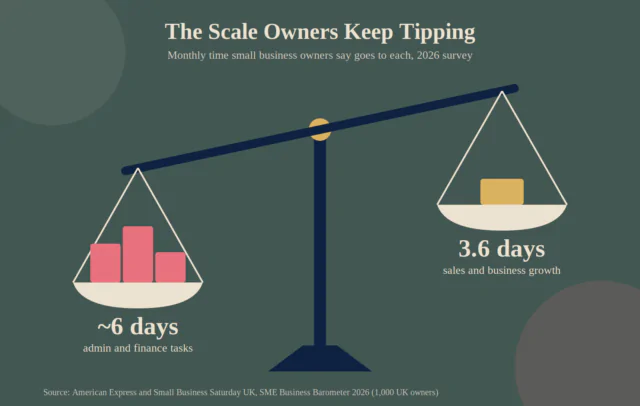
Her situation is common. American Express and Small Business Saturday UK found owners spend roughly six working days a month on admin and finance, compared with about 3.6 days on sales and business development. The survey covers UK owners, but the imbalance will feel familiar to many US owners too.
Step 1: The one-week audit
Dana logs every task for one normal week, including the quick ones. The result surprises her. Routine admin adds up to about 21.5 hours, spread across every day, mostly in small pieces. She also notices when it happens: early mornings before jobs start, lunch breaks and most evenings. Very little of it sits in a dedicated block, which is why it never felt like 20 hours. The audit is the step most owners skip, and it is the one that makes everything else possible.
The pieces matter as much as the total. A Harvard Business Review study found workers lose just under four hours a week reorienting after switching between apps and tasks. Dana’s admin is not one long block she could schedule around. It is dozens of interruptions.
Step 2: Where the 15 hours come from
Dana runs each task through a simple test: does it repeat, does it follow rules and is it easy to check? Six tasks pass.
| Task | Before (hrs/week) | After (hrs/week) | What changes |
|---|---|---|---|
| Inbox triage and routine replies | 6 | 2 | Assistant handles routine email, Dana answers only flagged messages |
| Scheduling and rescheduling | 4 | 1 | Assistant books and moves jobs using Dana’s rules |
| Invoicing and payment reminders | 3 | 0.5 | Assistant sends invoices and runs a reminder schedule |
| Bookkeeping data entry | 3 | 0.5 | Assistant enters transactions, Dana reviews monthly |
| Lead follow-up and quote prep | 3 | 1 | Assistant replies to new enquiries and drafts quotes |
| Social media posting | 2.5 | 0.5 | Assistant schedules posts from a monthly plan |
| Check-ins with the assistant | 0 | 1 | New time cost of managing the handover |
| Total | 21.5 | 6.5 | Net time returned: 15 hours |
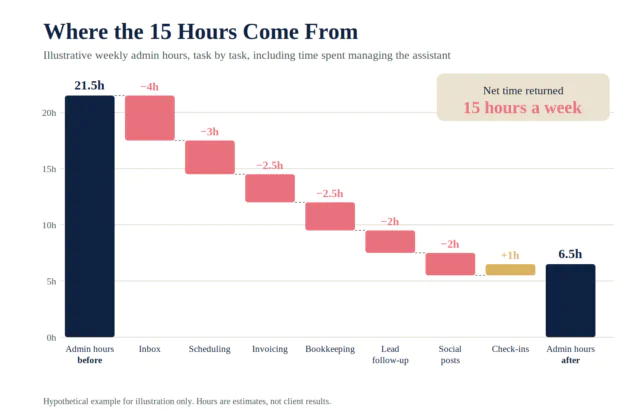
Notice the extra hour. Delegation is not free. Dana spends time each week reviewing work and answering questions, and the example counts it. If a plan for saving time does not include the time it takes to manage, it is not a real plan. The estimates are also deliberately conservative. Each task keeps some of Dana’s time, because she still reviews, approves and makes the calls only she should make.
Step 3: The handover, in stages
Dana does not hand everything over on day one. That is the most common way first delegation fails.
- Month 1: inbox and scheduling. These interrupt her most often, so they come first. Her assistant starts with drafts, then moves to sending routine replies alone.
- Month 2: invoices and bookkeeping entry. With written rules for reminders and a monthly review with her accountant, money admin leaves her evenings.
- Month 3: lead follow-up and social posting. Every new enquiry now gets a same-day reply, and posts go out on schedule.
At each stage, her assistant starts with drafts and checklists, and only works independently once the work is consistently right.
Inbox and calendar support is often the right first step for owners like Dana, which is why it sits at the center of executive assistant services.
Step 4: Where the time actually goes

Freed hours disappear fast if nothing claims them. Dana blocks them on purpose: two mornings a week for commercial sales calls, one afternoon for checking in with key clients and Friday afternoons off. She also stops answering email after 7 p.m., because routine messages now have someone to handle them during the day.
That last part matters. Bluevine’s 2026 research found 53% of small business owners felt emotionally drained or burned out in the past year. Getting time back is not only about growth. It is also about running the business without running yourself down.
What could make the number smaller or bigger
- Smaller: if your admin is light, your tasks change daily or you skip writing processes down.
- Bigger: if you handle lots of client communication, scheduling-heavy work or multiple locations.
- Slower: if you hand everything over at once or judge the results after week one.
It also helps to separate time saved from time moved. Some tasks will not disappear. They shift to a short review, which still wins, because reviewing takes a fraction of the focus that doing does. Your number will be different. The method is what transfers. If you are still deciding whether help makes sense at all, start with is hiring a virtual assistant worth it.
How to run the same math on your week
- Track one normal week and note every task and roughly how long it took.
- Mark the tasks that repeat, follow rules and are easy to check.
- Estimate before and after hours for each, and add one hour a week for check-ins.
- Hand over two tasks first, then add more each month.
- Decide in advance where the freed hours will go.
For a longer-term system that keeps working as you grow, see how to build a delegation system.
Frequently asked questions
How many hours a week do small business owners spend on admin?
It varies, but a 2026 American Express survey of 1,000 UK small business owners found an average of about 11 hours a week on admin and finance tasks. Owners who handle all client communication themselves often spend more.
Can a virtual assistant really save 15 hours a week?
It can, if you have that much routine, rule-based admin to hand over and you do it in stages. The example in this article is hypothetical. Your result depends on your tasks, your documentation and how consistently you review the work.
How long does it take to get the time back?
In most cases, gradually over the first few months. The first weeks take extra time for setup and explanations, and savings grow as each task moves from drafts to independent work.
Which tasks save the most time when delegated?
Usually the ones that interrupt you most often, such as inbox triage and scheduling, followed by invoicing, bookkeeping entry and lead follow-up.
Does managing an assistant take time?
Yes. Plan for short daily check-ins at first and around an hour a week once things are running. Counting that time keeps your expectations realistic.
Should I use a freelancer or a dedicated virtual assistant?
For ongoing weekly work like this, a dedicated assistant usually fits better. This comparison of virtual assistant vs in-house hire vs freelancer explains the trade-offs.
What to do next
Run the one-week audit before making any hiring decision. The number you find will tell you more than any estimate, including this one.
Expansion Desk matches business owners with vetted, trained assistants, with a dedicated onboarding support team to help the handover happen in stages. See how a virtual assistant for small business could take on your first tasks.
Want help working out your own number? Book a free discovery call and bring your one-week task list.
Sources
- American Express and Small Business Saturday UK, SME Business Barometer (July 2026), reported by Startups Magazine. startupsmagazine.co.uk
- Murty, Dadlani and Das, How Much Time and Energy Do We Waste Toggling Between Applications? Harvard Business Review, 2022. store.hbr.org
- Bluevine, Small Business Burnout Report (2026). bluevine.com