

Every owner has a list of jobs they keep meaning to hand off. Next month, after the busy season, once things calm down. Things rarely calm down. Meanwhile, the work that grows the business waits.
Most of what fills an owner’s week is not strategy or sales. It is small, repeatable admin, and it is exactly the work a good virtual assistant agency is set up to take off your plate.
Below are the seven tasks worth handing over first, the research on what each one quietly costs and a simple test to decide what stays with you.
Executive summary
- Bookkeeping is the biggest weekly financial time drain for small business owners, cited by 42% in a 2026 Bluevine survey.
- Late invoices hurt more than cash flow. 29% of owners delayed paying themselves because of late or unpaid invoices, and 17% missed or nearly missed payroll.
- Slow follow-up loses leads. Harvard Business Review found firms that tried to reach a lead within an hour were nearly 7 times as likely to qualify it.
- The best tasks to delegate repeat, follow rules and are easy to check. Use the 3R test to decide.
- Some work should stay with you, including pricing, strategy, key relationships and hiring.
What tasks should a small business owner delegate first?
Small business owners should delegate tasks that repeat every week, follow clear rules and are easy to check: inbox triage, scheduling, bookkeeping data entry, chasing invoices, lead follow-up, social media posting and routine customer questions. These take hours of owner time but rarely need owner judgment.
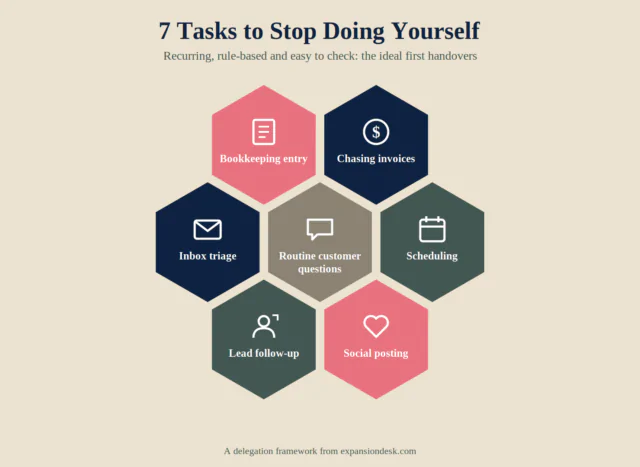
The 7 tasks to stop doing yourself
1. Inbox triage
Sorting, filing and answering routine email is the task most owners never put on a to-do list, yet it interrupts every hour of the day. An assistant working from simple rules can handle the routine messages, draft the rest and flag only what truly needs you. The real cost is not the minutes spent reading. It is the switching: every small reply pulls you away from work that needs your full attention, and getting back into it takes longer than the reply itself. For many owners, this is the one task costing the most time every week.
2. Scheduling and calendar management
Booking calls, rescheduling and sending reminders is pure back-and-forth. Give someone your availability rules once, and they can protect your calendar better than you can while you are busy. A good starting rule set covers which days you take calls, how much buffer you need between meetings, who can book you directly and which requests need your approval. Inbox and calendar work together is the core of executive assistant services.
3. Bookkeeping data entry
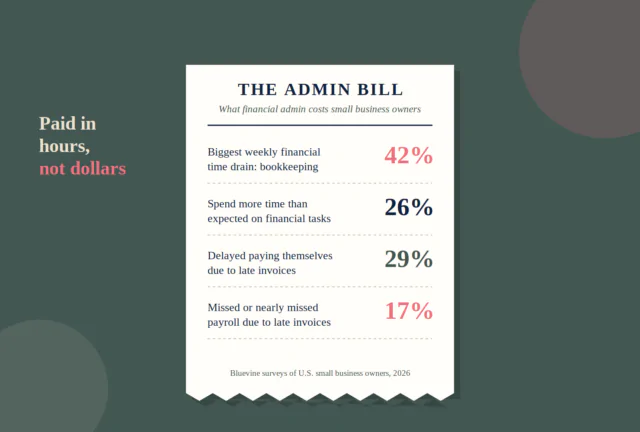
In Bluevine’s February 2026 survey of 785 U.S. owners, bookkeeping was the biggest weekly financial time drain, cited by 42%. About 26% said financial admin takes longer than they planned.
You still need to understand your numbers. You do not need to type in every receipt. Entering transactions, matching receipts and preparing reports for your accountant are all rule-based tasks. Keep a monthly review with your accountant so you stay close to the numbers while the data entry happens without you.
4. Sending invoices and chasing late payments
Late payments are not just a cash flow problem. Bluevine’s 2026 research on late payments found 29% of owners delayed paying themselves because of late or unpaid invoices, and 17% missed or nearly missed payroll.
Owners often put off follow-ups because they feel awkward. A polite, consistent reminder schedule run by someone else gets invoices paid without damaging the relationship. Agree the schedule once, for example a friendly reminder on the due date, a firmer one a week later and a call after two weeks, then let it run.
5. Lead follow-up and CRM updates

Harvard Business Review studied 1.25 million sales leads and found firms that tried to contact a lead within an hour were nearly 7 times as likely to qualify it as firms that waited even an hour longer, and more than 60 times as likely as firms that waited 24 hours or more.
The study is from 2011, but the lesson has only become sharper. When follow-up depends on a busy owner, leads wait. An assistant can log every enquiry, send the first response and book the call while the lead is still warm. Even a simple rule, like every new enquiry gets a reply within the hour during business hours, can make a visible difference.
6. Social media posting
Consistency matters more than brilliance, and consistency is the first thing to slip when you are busy. One planning session a month is usually enough to set the direction. Plan the themes yourself, then let someone else schedule posts, find images and reply to routine comments. A dedicated social media virtual assistant can own the calendar end to end.
7. Routine customer questions
Order status, opening hours, how to book and where to find a form are the same questions every week. Write the answers once, and someone else can respond faster than you ever could between meetings. Keep a shared document of approved answers and add to it whenever a new question comes up. Within a few months it covers most of what customers ask.
The 3R test: should you delegate this task?
Before handing anything over, ask three questions. If the answer to all three is yes, the task is ready to delegate.
| Question | Yes means | No means |
|---|---|---|
| Repeats? | It happens weekly or monthly, so explaining it once pays off | It is a one-off; probably faster to do yourself |
| Rule-based? | Someone can follow a checklist or examples | It needs your judgment every time; keep it or break it down |
| Reviewable? | You can check the result quickly | Mistakes would be hard to spot or undo; start with drafts only |
All seven tasks above pass this test for most businesses. If one does not pass in yours, start with drafts and approvals until it does. The test also protects you from a common trap: handing over the work you dislike rather than the work that is ready. Once a task passes, hand over the outcome and not just the steps, so you avoid the biggest delegation mistake owners make.
What you should keep doing yourself
- Pricing, strategy and major financial decisions
- Your most important client relationships
- Hiring and people decisions
- Anything involving legal or regulatory risk
Even here, someone else can gather information, prepare options and handle the follow-up. You keep the decision, not every task around it. If you are unsure whether this level of support suits you, read is hiring a virtual assistant worth it first.
What this looks like in practice
The example below is a hypothetical scenario to illustrate the process. It is not a real client.
Priya runs a small interior design studio. She uses the 3R test on her week and finds four tasks that pass: scheduling client visits, chasing invoices, posting project photos and answering “are you available in March?” enquiries.
She hands over scheduling and enquiries first, then invoices a month later. She keeps design decisions, pricing and her biggest clients. Her week is not suddenly empty, but the work left on her desk is now the work only she can do. The biggest change is not the hours. It is that she no longer starts each morning by clearing other people’s requests.
How to start this week
You do not need a big plan. You need a short list and one honest week of tracking.
- List every task you did last week, however small.
- Run the 3R test on each one.
- Pick the top two that pass and write a one-page checklist for each.
- Hand them over with a short daily check-in for the first few weeks.
- Add one more task each month as the first ones run smoothly.
Frequently asked questions
What tasks should small business owners delegate first?
Start with recurring, rule-based tasks that are easy to check: inbox triage, scheduling, bookkeeping data entry, invoice follow-ups, lead follow-up, social media posting and routine customer questions.
What should a business owner never delegate?
Keep pricing and strategy, your most important client relationships, hiring decisions and anything with legal or regulatory risk. Someone else can still prepare information and handle follow-up for these.
How do I know if a task is ready to delegate?
Use the 3R test. If the task repeats, follows clear rules and is easy to review, it is ready. If not, start with drafts and approvals until it is.
Is it worth delegating small tasks that only take a few minutes?
Often, yes. Small tasks scattered through the day cause constant interruptions. Grouping them and handing them to someone else can free far more focused time than the minutes suggest.
Can automation or AI handle these tasks instead of a person?
Some parts, yes. Tools can send reminders, sort email and draft replies. A person is still needed to check the output, handle exceptions and own the result. This comparison of AI agents and virtual assistants explains where each fits.
Should I hire a freelancer or a virtual assistant for these tasks?
For ongoing, recurring work, a dedicated assistant is usually the better fit. Freelancers suit one-off projects. This breakdown of virtual assistant vs in-house hire vs freelancer covers the trade-offs.
What to do next
Pick two tasks from this list that you did last week and should not have. That is your starting point.
Expansion Desk matches business owners with vetted, trained assistants, with a dedicated onboarding support team behind them. See how a virtual assistant for small business can take on your first two tasks.
Not sure which tasks to start with? Book a free discovery call and we can go through your list together.
Sources
- Bluevine, 3 in 4 Owners Say Owning a Business Is Worth It, Despite Challenges (survey of 785 U.S. owners, February 2026). bluevine.com
- Bluevine, Small Business Late Payment Gaps report (2026), as cited in the report above. bluevine.com
- Oldroyd, McElheran and Elkington, The Short Life of Online Sales Leads, Harvard Business Review, March 2011. hbr.org