

A clear-eyed comparison for founders deciding how to bring on help next
At some point, almost every founder hits the same fork in the road. The work has outgrown what one person can handle, and now there is a decision to make: hire someone in-house, bring on a freelancer for the specific gap, or work with a virtual assistant. Each option gets pitched as the obvious answer by someone who happens to sell exactly that option. None of them is wrong. But each one fits a different kind of problem, and picking the wrong one for your situation usually shows up later, as a role that costs more than it should, or one that never quite gets the attention it needed.
The freelance and remote-work landscape has shifted enough that the old default of just hiring someone is no longer the safest first move. Upwork’s 2026 Future Workforce Index found that 28 percent of U.S. knowledge workers now freelance or work independently, generating 1.5 trillion dollars in collective earnings, and only 10 percent say they want to return to traditional employment. That shift changes the math on all three options, including whether virtual assistant support makes more sense than either extreme.
The In-House Hire: What You’re Really Signing Up For
This is the option most people default to, because it is the one that feels the most permanent.
- You get someone who learns your business deeply, is available on your schedule, and builds context no outside help ever fully replicates.
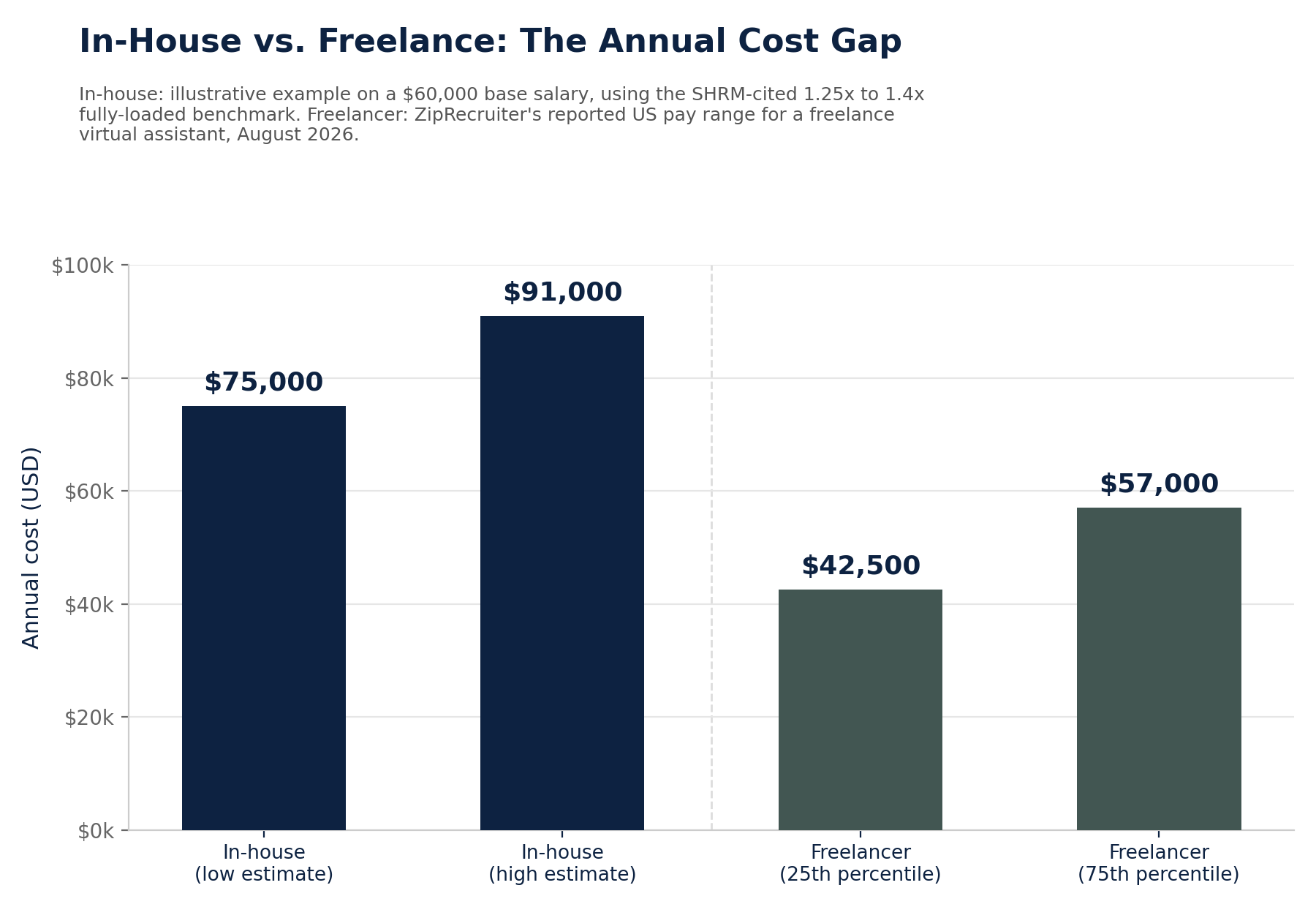
- You also take on the full cost. A fully loaded salary typically runs 1.25 to 1.4 times base pay once benefits, payroll tax, and overhead are counted, according to SHRM.
- Hiring itself takes weeks to months between sourcing, interviewing, and onboarding, time that is not free even before the role starts producing anything.
- If it does not work out, replacing the person means starting the entire process over, usually while the gap they were supposed to fill keeps growing.
The Freelancer: Fast and Flexible, Until It Isn’t
Freelancers solve a very specific problem well: a defined project with a clear start and end.
- You can usually start within days, and you are paying only for actual hours or deliverables, not a fixed salary regardless of workload.
- Rates vary widely by platform and skill. A freelance virtual assistant in the US averages around $24 an hour, according to ZipRecruiter’s 2026 salary data.
- Availability is not guaranteed. A freelancer juggling multiple clients may not be reachable when something is urgent, and quality varies from one person to the next.
- There is usually no one managing the relationship but you, which means onboarding, quality checks, and continuity all fall back onto your own time.
The Virtual Assistant: The Middle Path Most Founders Skip
A virtual assistant sits between the other two: more structure than a freelancer, less overhead than a full hire.
- Most agencies pre-vet and match you with someone suited to the role, closer to how instant virtual assistants work than a traditional hire, so you are not sourcing or interviewing from scratch.
- The engagement is typically a flat monthly rate rather than an hourly bill that swings with workload, which makes budgeting far more predictable.
- For work that needs real expertise, skilled virtual assistants come trained in a specific discipline rather than general admin support alone.
- Most providers offer a replacement if the match is not right, so a bad fit costs you a conversation, not a repeat of the entire hiring process.
The dollar difference between the two ends of this spectrum is larger than most founders expect.
Which One Actually Fits Your Business
The right choice usually comes down to what kind of work you are trying to cover, not which option sounds cheapest on paper.
- Running a brokerage and drowning in showings and follow-up? A real estate virtual assistant is built specifically for that workflow.
- Managing patient scheduling and records? A medical virtual assistant already understands healthcare intake and the basics of staying compliant.
- Books piling up every month? A bookkeeper VA keeps them current without the cost of a full-time controller.
- Traffic stuck and rankings flat? A SEO virtual assistant can own that work full time instead of squeezing it into a Friday afternoon.
- Social channels gone quiet? A social media virtual assistant keeps a consistent posting and engagement schedule running.
- Calendar and inbox eating your mornings? An executive assistant is the closest thing to cloning your own judgment for the routine decisions.
- Need the website built or maintained, or campaigns actually run? A web developer or paid ads specialist can take that off your plate without a full marketing hire.
Side by Side
Here is the same comparison without the storytelling.
| Attribute | In-House Hire | Freelancer | Virtual Assistant |
| Speed to start | Weeks to months | Often within days | Typically days, pre-vetted |
| Cost structure | Fixed salary + benefits + overhead | Hourly or per project | Flat monthly rate |
| Oversight needed | Full management, HR, reviews | Self-directed, but you chase updates | Managed relationship, light oversight |
| Consistency | High once hired, slow to replace | Depends on their availability | Backed by a replacement guarantee |
| Best fit for | A role core to the business long term | A one-off project, clear finish line | Ongoing recurring work |
| Access to skills | Limited to who you can recruit | Wide, but quality varies | Wide, pre-vetted by specialty |
| If you need… | Best fit |
| Need judgment and long-term context | In-house hire |
| Need a defined project done and finished | Freelancer |
| Need ongoing, recurring support | Virtual assistant |
How to Decide This Week
You do not need a perfect answer, just a reasonable one you can adjust later.
- List what the role actually needs. Judgment and long-term context, a defined deliverable, or ongoing recurring support.
- If it is recurring but not core to the business long term, default to a virtual assistant before jumping straight to a full hire.
- If it is a one-time project with a clear finish line, a freelancer is usually the faster, cheaper route.
- If the role touches strategy, culture, or decisions only you should make, that is the case for hiring in-house.
- Whichever you choose, set a 30-day check-in. The cost of switching early is far lower than the cost of waiting a year to admit it is not working.
Frequently Asked Questions
Is a virtual assistant the same as a freelancer?
Not quite. A freelancer is typically an independent contractor you find and manage yourself. A virtual assistant is usually matched and supported by an agency, with vetting, replacement coverage, and account management built in.
Is hiring in-house always better for long-term roles?
Not always. It is the right call when the role needs deep institutional knowledge or decision-making authority. For long-term but well-defined recurring work, a virtual assistant often delivers the same consistency without the fixed overhead.
How much cheaper is a virtual assistant than an in-house hire?
It depends on the role and provider, but the gap comes mostly from avoiding payroll tax, benefits, and office overhead, the same costs that push an in-house hire’s fully loaded cost to 1.25 to 1.4 times base salary.
Can I switch between these options later?
Yes, and most founders do. It is common to start with a freelancer for a single project, move to a virtual assistant once the work becomes recurring, and hire in-house only once a role clearly needs to be core to the team.
What if I only need a few hours a week?
That is usually too little to justify an in-house hire and often too inconsistent for a freelancer’s minimums. A virtual assistant arrangement can typically flex to part-time hours without losing the managed, vetted structure.
Ready to Bring On the Right Kind of Help?
If the comparison above points toward a virtual assistant, the next step is simple. ExpansionDesk matches USA based businesses with vetted virtual assistants across nine specialized roles, typically in days rather than months, and backed by a 90 day replacement guarantee. Ready to hire your first virtual assistant today and see which role fits first?

- GPT-6 Astra Just Launched, Does That Mean You Don’t Need a Virtual Assistant Anymore? - September 14, 2026
- AI Agents vs Virtual Assistants: What Actually Gets Small Businesses Better Results in 2026 - September 11, 2026
- Virtual Assistant vs In-House Hire vs Freelancer: Which One Actually Fits Your Business - September 9, 2026