
Cutting through the hype to see which one actually moves the needle for your business
Every small business feed is currently full of the same pitch, the one where you install an AI agent and watch your workload disappear. It answers messages while you sleep, never asks for a day off, and costs less than a streaming subscription. It is a genuinely appealing story, and part of it is true. But 2026 has also been the year the hype started running into real numbers, and those numbers tell a more complicated story than the ads do.
The backdrop matters here. Hiring has gone quiet across the US, JPMorgan’s 2026 Business Leaders Outlook found that only 12 percent of midsize businesses plan to reduce headcount this year, but almost nobody is expanding either, which means existing teams are simply being asked to absorb more. That is exactly the gap AI agents are being marketed to fill, and exactly the gap virtual assistant support has been filling for years. The honest question for 2026 is not which one sounds newer, it is which one actually gets the work done.
The AI Agent Pitch: Fast, Cheap, Always On
The appeal is real. A typical small business AI agent platform runs anywhere from free to around 115 dollars a month once messaging fees are included, according to pricing breakdowns published in 2026, with most tools landing in the 35 to 115 dollar range for meaningful coverage. For a narrow set of jobs, that is a genuinely good deal. It covers answering frequently asked questions, confirming a booking, sending a reminder, or handling the first reply to an inbound message at 2 a.m. Those are real hours given back, and no one should pretend otherwise.
Why 40 Percent of AI Agents Projects Are Getting Canceled
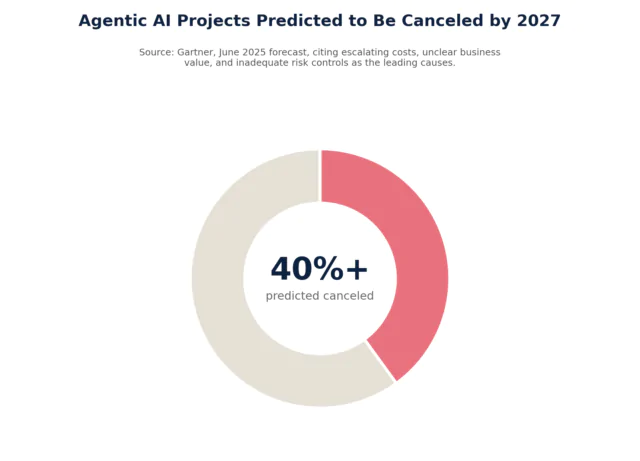
Here is the number that should give every small business pause. Gartner predicts that over 40 percent of agentic AI projects will be canceled by the end of 2027. Their analysts point to three reasons, escalating costs that outpace the promised savings, unclear business value once the novelty wears off, and inadequate risk controls for anything customer-facing. Gartner has also flagged a credibility problem underneath all of it, of the thousands of vendors marketing agentic AI, they estimate only around 130 have real agentic capability behind the pitch, the rest is largely relabeled automation.
None of that means AI agents are worthless. It means the maturity gap is real, and the businesses getting burned are usually the ones that handed over judgment calls the tool was never built to make.
Not Every AI Agent Is a Weekend DIY Project
Part of what is driving Gartner’s cancellation numbers rarely makes it into the marketing copy. Plenty of these tools are pitched as install-and-go, but making one dependable enough for real customers is a different job entirely. Connecting it to your actual order, booking, or inventory data, writing the guardrails that keep it from guessing, and testing it against the messy, off-script questions real customers send takes real technical setup work. Some agents genuinely are simple enough for an owner to configure in an afternoon. Plenty of others are not, and a business that treats a complex agent like a plug-and-play tool is exactly the kind of project Gartner expects to land in the canceled pile, usually after real money and real customer trust have already been spent on it.
The Hallucination Problem the Pitch Leaves Out
The other thing rarely mentioned in the demo is that AI agents still confidently make things up. Industry data on AI-handled customer service tickets puts hallucination related complaints at a small but real 0.34 percent of tickets, dropping to roughly 0.11 percent when the tool is properly grounded in real business data. That sounds low, until you weigh it against the reputational cost of even one bad answer. Despite that low rate, 71 percent of customer experience leaders still rank hallucination as one of their top three governance risks, and nearly half of AI support programs now require a human to review any AI response that quotes a dollar figure, a policy, or a promise to a customer. A virtual assistant does not need that safety net. A person who is unsure says so, or checks, instead of inventing an answer with total confidence.
What a Human Virtual Assistant Actually Adds
This is where the comparison gets interesting instead of one-sided. A skilled virtual assistant brings exactly what Gartner’s analysts say most agentic AI still lacks, the ability to read an ambiguous request, weigh context that was never written down anywhere, and make a reasonable call without escalating every edge case back to you.
- A returning client asks for something slightly outside the usual scope. A person recognizes the relationship and the history, an AI agent either refuses or improvises badly.
- A scheduling conflict needs a judgment-based tradeoff, not a rule. A person can weigh it, a scripted flow usually cannot.
- Trust builds over months of consistent work. AI agents mostly reset context between sessions, so continuity is limited by design.
- Accountability matters when something goes wrong. A person can explain a decision, own a mistake, and adjust. A tool cannot be held to that standard.
So Which One Should You Actually Use in 2026
The honest answer for most small businesses is not either, it is both, aimed at different jobs.
| Task | AI Agent | Virtual Assistant |
| Answering routine questions fast | Handles well, any hour | Handles well, business hours |
| Following up when a lead goes quiet | Consistent, but scripted | Reads the room, adjusts tone |
| Judgment calls on an unusual request | Struggles, often escalates or guesses | Handles well |
| Remembering context over months | Limited, resets often between sessions | Builds real context over time |
| Managing a multi-step client relationship | Not reliable yet | Handles well |
| Admitting uncertainty instead of guessing | Inconsistent, can hallucinate | Asks or checks before answering |
An instant virtual assistant or a general virtual assistant can absorb the judgment-heavy work an AI agent keeps getting wrong, while a simple AI tool handles the truly repetitive first line of contact. That combination tends to outperform either option running alone.
A Simple Way to Decide
- If the task is genuinely repetitive and low stakes, an AI agent can probably handle it, and cheaply.
- If getting it wrong would cost you a client or a refund, that task belongs with a person, not a script.
- If you already tried an AI tool and it is escalating constantly, that is the Gartner pattern playing out, and it is a sign to add human coverage rather than add more automation.
- If you are stretched thin but not ready to hire, a virtual assistant closes that gap faster than a full-time role and more reliably than an unsupervised agent.
Frequently Asked Questions
Why are so many agentic AI projects getting canceled?
Gartner points to escalating costs once real usage kicks in, unclear return on the investment, and risk controls that were not built out before launch. A lot of it also traces back to tools marketed as agentic that are not much more than basic automation.
Can a small business use both at the same time?
Yes, and it is often the strongest setup. Let an AI tool handle the truly repetitive first response, and let a person handle anything that involves judgment, tone, or an actual relationship.
What should I hand to a human first if I am already using an AI agent?
Start with whatever is currently getting escalated the most. That is usually the clearest signal of where the tool has hit its ceiling.
Is this an anti-AI argument?
No. AI agents are genuinely useful for the narrow jobs they are built for. The point is matching the tool to the task instead of assuming either option can do everything.
Do AI agents actually hallucinate answers to real customers?
Yes, though it happens less often than the horror stories suggest. Industry data puts hallucination related complaints at roughly 0.34 percent of AI-handled tickets, but the reputational cost of even one confidently wrong answer is high enough that most CX teams now require human review before an AI agent can quote a price, policy, or promise.
Our Take Heading Into Q4 2026
We prefer to use a virtual assistant over an AI agent for this final quarter of 2026. Small and medium-sized companies are still waiting on an AI that is easy to set up without professional help and that does not hallucinate. Until that exists, hire your first virtual assistant today and cover the work that actually needs a person.

- GPT-6 Astra Just Launched, Does That Mean You Don’t Need a Virtual Assistant Anymore? - September 14, 2026
- AI Agents vs Virtual Assistants: What Actually Gets Small Businesses Better Results in 2026 - September 11, 2026
- Virtual Assistant vs In-House Hire vs Freelancer: Which One Actually Fits Your Business - September 9, 2026