

“We’re too small for that.” Owners say it about accountants, about software, about marketing help. And almost always about virtual assistants. Is my business too small for a virtual assistant?
Sometimes it is true. More often, it is a way of not looking too closely at how the week is actually spent. This article does not try to talk you into anything. It gives you the tests to find out which one applies to you, before you spend a dollar with any virtual assistant company.
Is my business too small for a virtual assistant? The short answer
Team size does not decide whether you need a virtual assistant. Repeatable work does. If you spend five or more hours a week on admin that follows clear rules, repeats every week and keeps you from sales, clients or rest, you are not too small. If you do not, you probably are, for now.
- Being small is normal, not a reason. 82.3% of America’s 36.2 million small businesses have no employees at all, according to the SBA Office of Advocacy.
- You do not need a full-time hire. Five hours a week is a real starting point. At common freelance rates, that is roughly $217 to $433 a month.
- There are real reasons to wait, and this article lists them honestly.
Take the 60-second check
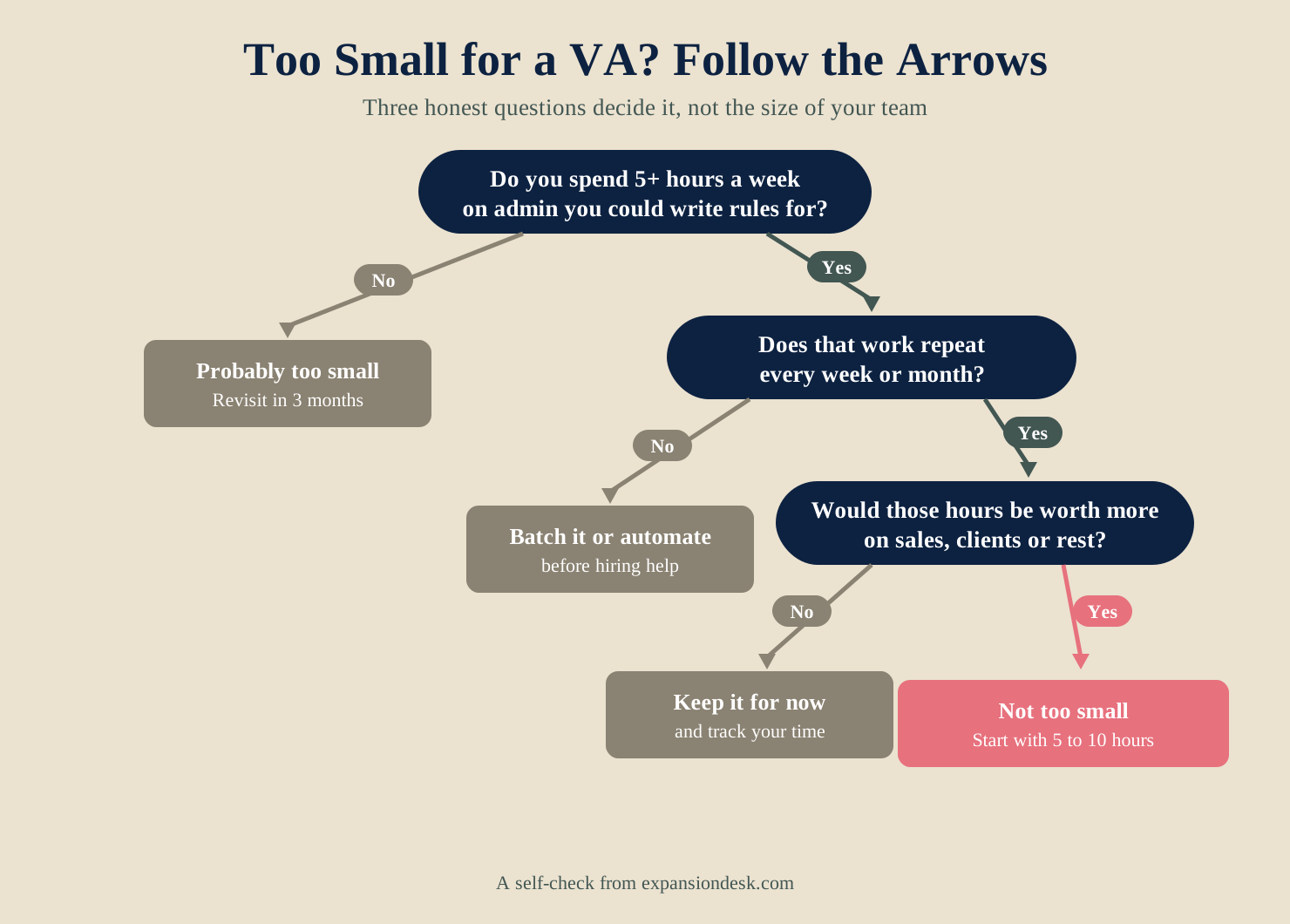
Follow these questions with your own week in mind. Three questions matter, and none of them is about how many people you employ:
- Do you spend five or more hours a week on admin you could write rules for? Think inbox sorting, scheduling, invoicing, data entry and follow-ups.
- Does that work repeat every week or month? One-off jobs are rarely worth handing over. Recurring ones almost always are.
- Would those hours be worth more spent on sales, clients or rest? If yes, the hours have a cost, whether or not you see an invoice for them.
If you answered yes three times, size is not your problem. If you answered no to the first question, you may genuinely be too small right now.
Why “too small” feels true
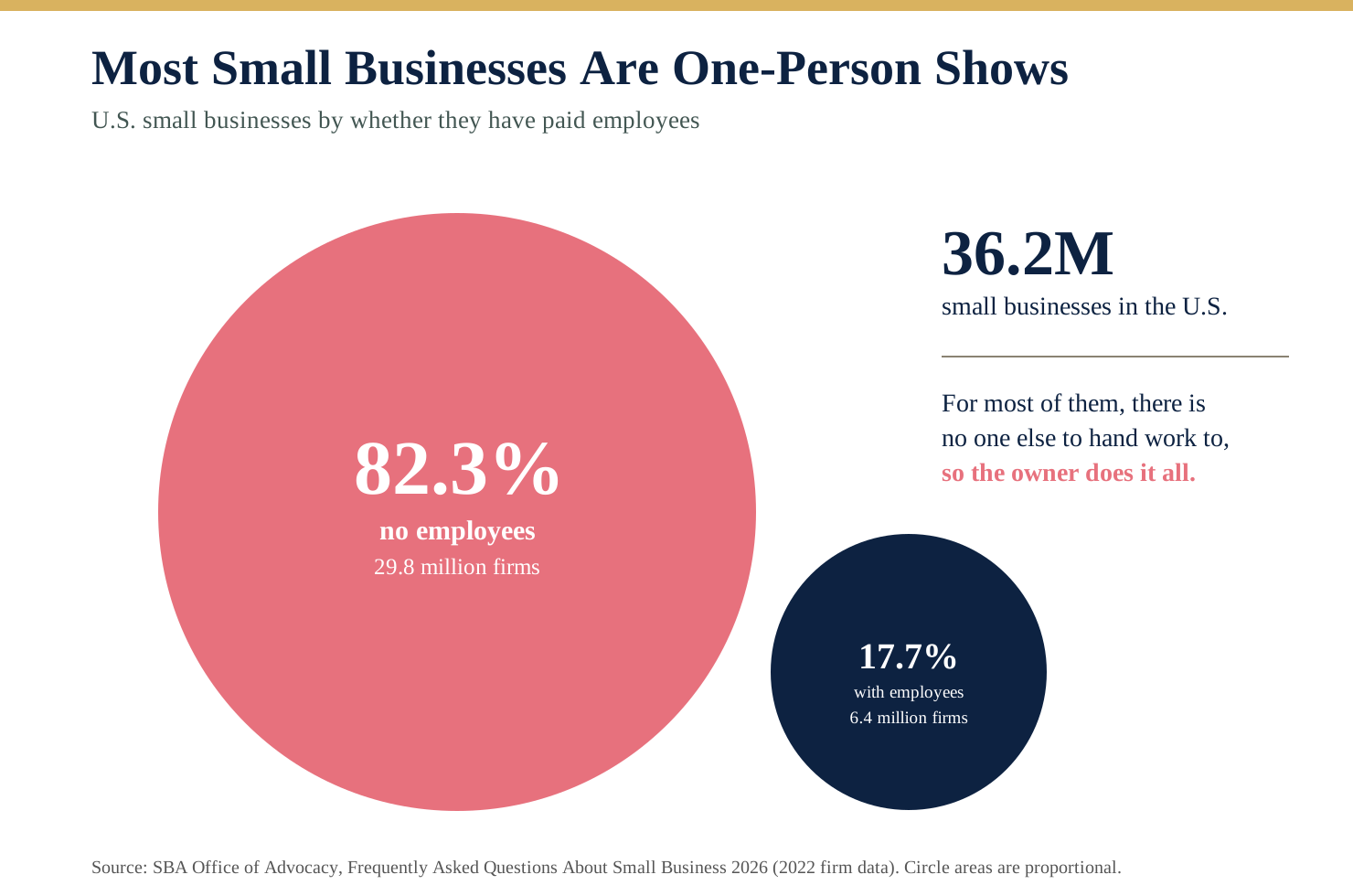
The SBA Office of Advocacy counts 36.2 million small businesses in the United States. Of those, 82.3%, or about 29.8 million, have no paid employees. Only 17.7% employ anyone at all.
So if you are a solo owner or a tiny team, you are the typical small business, not the exception. That is exactly why “too small” feels so reasonable: almost everyone around you is doing everything themselves too. But common is not the same as efficient. It just means the hidden cost of doing it all is shared by millions of owners who never measure it.
6 excuses for being too small for a virtual assistant, examined
Each excuse below has some truth in it. The useful question is not whether it sounds reasonable, but whether it survives a simple test.
“I don’t have enough work to fill a job.”
What’s true: you may not have 40 hours of admin. What’s missed: virtual assistants are not only full-time. Part-time arrangements of five to 20 hours a week are common. The test: add up last week’s admin. If it is five hours or more, there is enough work to start.
“I can’t afford it yet.”
What’s true: cash flow is real, and help should never put payroll at risk. What’s missed: the comparison is not VA cost against zero. It is VA cost against the value of your hours. The test: work out what one extra sales call or client hour a week is worth to you. This guide to whether you can afford to hire a virtual assistant walks through the math.
“It’s faster if I just do it myself.”
What’s true: the first time, it is. What’s missed: you are comparing one explanation with a lifetime of doing the task. The test: if a task takes 30 minutes a week, you will spend about 26 hours on it this year. Explaining it once takes far less.
“My work is too specialized for someone else.”
What’s true: your core work probably is. What’s missed: the admin around it usually is not. Booking, billing, chasing and filing look the same in most businesses. The test: split your week into the work only you can do and the work around it. Hand over only the second list.
“I’ll hire help once we’re bigger.”
What’s true: a big hire makes more sense with more revenue. What’s missed: growth needs time, and that time is often what admin is eating. It is a circle: too busy to grow, too small to get help. The test: ask what you would do with five extra hours a week. If the answer is growth work, waiting may be what keeps you small. This piece on a staffing problem versus a capacity problem explains the difference.
“I tried a freelancer once and it didn’t work.”
What’s true: bad first experiences are common. What’s missed: they are usually caused by vague tasks and no check-ins, not by the idea of delegating. The test: look at what you handed over. If it was a pile of tasks with no rules, the setup failed, not the concept.
Notice the pattern. Almost every excuse is about the business as it might look someday, bigger, richer or less busy. The tests are about the week you just had. Decisions based on last week’s real numbers are usually better than decisions based on how the business feels.
“Small” is not one size
What small looks like changes what a first virtual assistant should do. These illustrative profiles show typical starting points. They are examples, not client results.
| Business | Typical admin pressure | Sensible first handover | Starting hours |
|---|---|---|---|
| Solo owner or consultant | Inbox, scheduling and invoicing squeezed into evenings | Inbox triage and calendar | 5 a week |
| Micro team, 2 to 5 people | Owner fields every client request and approval | Scheduling, follow-ups and CRM updates | 10 a week |
| Small team, 6 to 20 people | Admin spread thin across people hired for other jobs | Shared admin, customer questions and reporting | 20 or more a week |
The minimum viable VA
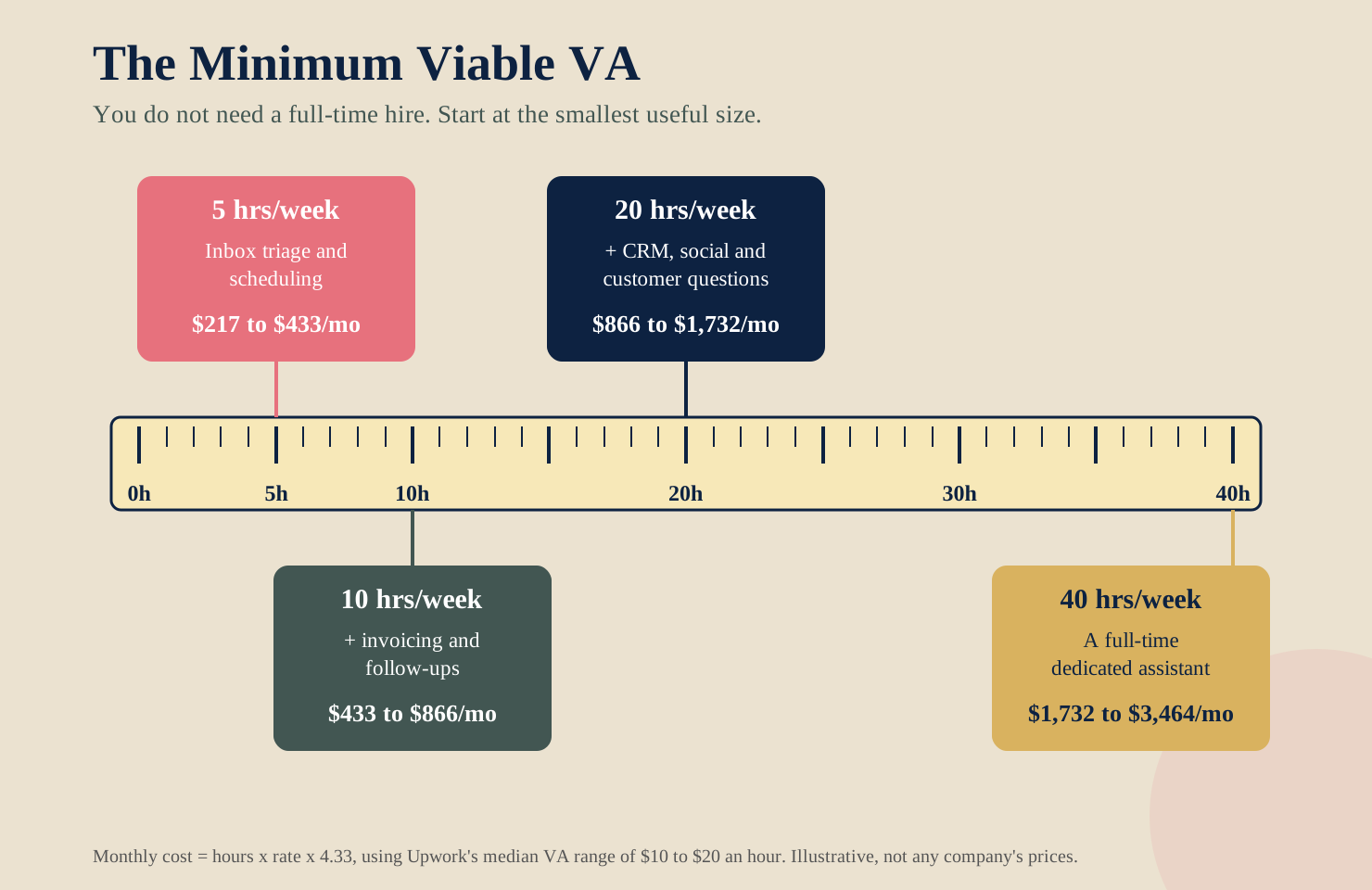
You do not need to commit to a full-time assistant to find out whether help works for your business. Start at the smallest size that removes a real problem, then grow only if it pays off. Treat the first three months as a trial with a clear question: did the hours you got back go somewhere useful?
At Upwork’s median virtual assistant range of $10 to $20 an hour, five hours a week costs roughly $217 to $433 a month. Ten hours is roughly $433 to $866. Rates vary by country, skill and platform, so treat these as illustrative, not quotes.
Five hours a week is usually enough to take inbox triage and scheduling off your plate, the two tasks that interrupt owners most often. That is also the core of executive assistant services, which is why it is a common first step.
When your business really is too small for a virtual assistant
Being honest about this matters. Wait, at least for now, if:
- Your recurring admin is under five hours a week.
- Your cash flow cannot comfortably cover a small monthly cost for three months.
- Your work changes every day and nothing repeats.
- You cannot spare a few hours in the first month to explain how things work.
If that is you, start by tracking your time for a month and writing down your most common tasks. When the numbers change, you will know. And when they do, this guide on how to build a delegation system will help you start properly.
Frequently asked questions
Is my business too small for a virtual assistant?
Probably not, if you spend five or more hours a week on recurring, rule-based admin that keeps you from sales, clients or rest. Team size matters far less than how much repeatable work you have.
Can a solo business owner hire a virtual assistant?
Yes. Many solo owners start with five to ten hours a week for inbox triage, scheduling and invoicing. The SBA reports that 82.3% of U.S. small businesses have no employees, so solo owners are the typical small business.
How many hours a week do I need to hire a virtual assistant?
There is no minimum rule, but five hours a week is a practical starting point. Below that, batching or automating the work may be simpler than handing it over.
How much does a part-time virtual assistant cost?
At Upwork’s median range of $10 to $20 an hour, five hours a week is roughly $217 to $433 a month, and ten hours is roughly $433 to $866. Actual rates depend on skill, location and how you hire.
What should a small business delegate first?
Start with the tasks that interrupt you most and follow clear rules, usually inbox triage and scheduling. Then add invoicing, follow-ups and CRM updates as the first tasks run smoothly.
When is a business genuinely too small for a VA?
When recurring admin is under five hours a week, nothing repeats, cash flow cannot cover a small monthly cost or you cannot spare any time in the first month to explain the work.
Your next step
Run the 60-second check against last week, not an average week. If it says you are not too small, start with five hours and two tasks. If it says wait, track your time and check again in three months.
Expansion Desk matches business owners with vetted, trained assistants, with a dedicated onboarding support team behind them. See how a virtual assistant service for smaller teams can start small and grow with you.
Not sure which side of the line you are on? Book a free discovery call and we will look at your numbers together.
Sources
- SBA Office of Advocacy, Frequently Asked Questions About Small Business 2026. advocacy.sba.gov
- Upwork, How Much Does It Cost to Hire a Virtual Assistant? upwork.com

- How to Do a Time Audit as a Business Owner (Free Template) - November 11, 2026
- Everyone Is Talking About AI Taking Over Small Business, Here Is What Is Actually True - November 4, 2026
- What Successful Business Owners Do Differently When They Scale - November 4, 2026