

You held out for months. Then you finally brought in help. Three weeks later, you are somehow busier than before: answering questions, approving drafts and redoing work that came back wrong.
It is easy to blame the person you hired, or to decide that working with a virtual assistant agency just is not for you. Most of the time, the problem is how the work was handed over.
Here is the mistake almost every owner makes the first time, why it happens and how to fix it before it costs you the help you waited so long to get.
Executive summary
- The biggest mistake is handing over tasks but keeping the ownership. The helper does the work, but every decision still comes back to you.
- It usually starts with waiting too long. Bluevine found 68% of owners delayed or avoided a major decision, such as hiring, because of financial stress.
- By then, owners are running on empty. Patriot Software found 84.6% of owners have made a significant personal sacrifice for the business.
- Even experienced leaders find this hard. Stanford and The Miles Group found delegation is the top area CEOs work on with coaches.
- The fix is to hand over outcomes, not tasks, and to move the helper up an ownership ladder step by step.
What is the biggest mistake owners make when they ask for help?
The biggest mistake is delegating the doing but not the deciding. The owner hands over a task, keeps every decision attached to it and becomes the person the new helper has to check with. The work leaves your desk and comes straight back as questions, approvals and corrections.
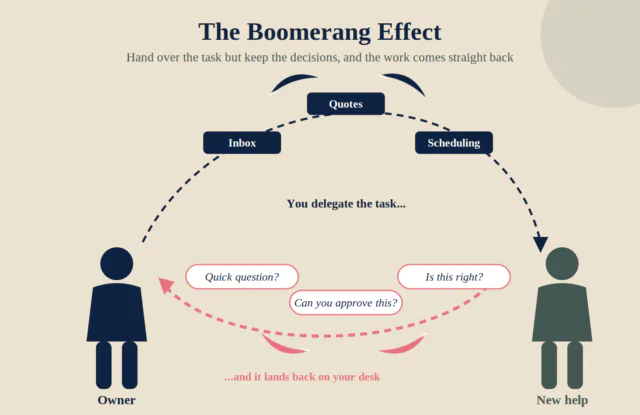
Call it the boomerang effect. You still own the result, so you still own the work, only now there are two people involved instead of one. The frustrating part is that it looks like the helper is the problem, because they keep asking questions. Usually they were simply never told what they are allowed to decide.
Why owners wait so long, and why that makes it worse

A 2026 Patriot Software survey of 1,000 small business owners and managers found only 15.4% report no significant personal sacrifice for their business. Bluevine’s 2026 research found 53% of owners felt emotionally drained or burned out in the past year, and 68% delayed or avoided a major decision such as hiring because of financial stress.
That timing matters. When help finally arrives, it arrives in a crisis. There is no time to explain anything properly, so owners dump a pile of tasks and keep the decisions, because handing those over feels too risky when everything is already on fire. If this sounds familiar, this guide on how to scale without burning out is worth reading alongside this one.
3 ways the mistake shows up
1. You hand over leftovers, not systems
The first things owners give away are often the tasks they dislike most, whether or not they repeat. One-off errands teach a helper nothing they can use next week. Recurring work with a clear pattern, like scheduling, data entry or posting, is what builds real capacity. A good test: if you will need the same task done next month, hand it over. If you will not, it is probably not worth the explanation.
2. You keep every decision
If your helper cannot send a reply, book a meeting or fix a small problem without asking you, you have not delegated the job. You have added a step to it. This is how owners stay stuck as the bottleneck in their own business even after they hire.
3. You check everything twice
Reviewing early work makes sense. Reviewing every piece of work forever means you are doing the job twice. If nothing ever moves to “I trust this,” the problem is usually that “good” was never defined, not that the helper is not capable. Agree on what good looks like up front, check the first five pieces of work closely, then switch to spot checks. If this is your first hire, these things nobody tells you before your first virtual assistant will help you set expectations early.
The fix: hand over outcomes, not tasks
A task tells someone what to do. An outcome tells them what success looks like and leaves room to get there. That small change is what stops the boomerang.
| Handing over a task | Handing over an outcome |
|---|---|
| “Reply to these emails.” | Every client email gets a reply within one business day. Anything about pricing or complaints comes to me with a short summary. |
| “Post this on Instagram.” | Three posts go out each week from the content calendar. You choose the images and captions within the brand guide. |
| “Update the CRM.” | Every new lead is in the CRM with a follow-up date within 24 hours of first contact. |
| “Book my meetings.” | Client calls land in the afternoon, nothing before 10 a.m., and Fridays stay clear unless I say otherwise. |
Outcomes also make specialist help easier to use. A social media virtual assistant, for example, can own a posting schedule end to end once the outcome and brand rules are clear, instead of waiting for you to approve every caption.
Use the ownership ladder
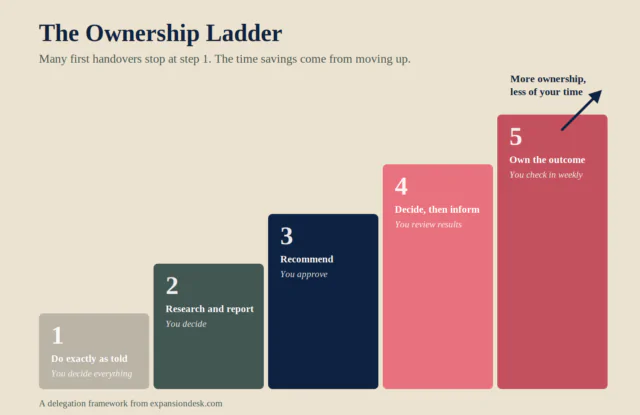
Not every task should jump straight to full ownership. Think of delegation as five steps: do exactly as told, research and report, recommend, decide then inform, and finally own the outcome.
Most first handovers stall at step one, which keeps you involved in every detail. Aim to move each recurring task up one step every few weeks as trust builds. A practical rule: if a task has gone a month without a mistake that mattered, it is ready for the next step. Even seasoned leaders find this difficult. In the Stanford and Miles Group executive coaching survey, sharing leadership and delegation was the top area CEOs were working to improve.
What this looks like in practice
The example below is a hypothetical scenario to illustrate the process. It is not a real client.
Jordan runs a small online store and finally hires help after a brutal holiday season. In the first month, he hands over customer emails but asks to approve every reply. His assistant sends him 30 drafts a day, and Jordan feels busier than ever.
He changes one thing. He writes down the outcome (every order question answered the same day, refunds over an agreed amount come to him) and moves the assistant to step four on the ladder. Within weeks, Jordan sees a short daily summary instead of 30 drafts. The assistant did not change. The handover did.
When keeping control is the right call
Some things should stay with you, at least for now:
- Pricing, strategy and major financial decisions
- Sensitive client relationships and complaints
- Hiring and people decisions
- Anything with legal or regulatory risk
The aim is not to give everything away. It is to stop routine work from bouncing back to you. Even for the decisions you keep, a helper can gather the information, draft options and handle the follow-up. You keep the decision, not all the work around it.
How to hand over ownership without losing control
- Pick recurring work, not one-off errands.
- Write the outcome in one or two sentences for each task.
- Set clear limits, such as amounts, topics or clients that always come to you.
- Choose a starting step on the ownership ladder, usually step two or three.
- Review results weekly, not every individual piece of work.
- Move up a step once the outcome is met consistently.
For a fuller system that keeps working as you add more people, see how to build a delegation system.
Frequently asked questions
What is the biggest mistake owners make when they delegate?
Handing over tasks but keeping all the decisions attached to them. The helper does the work, but every question, approval and correction still comes back to the owner, so very little time is actually saved.
Why do small business owners wait so long to ask for help?
Usually a mix of cost worries, time pressure and the belief that explaining the work will take longer than doing it. Bluevine found 68% of owners delayed or avoided a major decision such as hiring because of financial stress.
What is the difference between delegating a task and delegating an outcome?
A task describes what to do, such as “reply to these emails.” An outcome describes what success looks like, such as “every client email answered within one business day,” and gives the person room to decide how to get there.
How do I delegate without micromanaging?
Define the outcome, set clear limits on what always comes to you and review results weekly instead of checking every piece of work. Move the person up one level of ownership once they meet the outcome consistently.
What should I never delegate as a business owner?
Keep pricing and strategy, sensitive client relationships, hiring decisions and anything with legal or regulatory risk. Almost everything routine around those decisions can be handed over.
How long does it take before delegating actually saves time?
It depends on how clearly the outcome is defined and how often the task repeats. Recurring work with written outcomes tends to save time sooner than vague, one-off requests.
What to do next
Pick one task you have already handed over and rewrite it as an outcome this week. That one change is often enough to stop the boomerang.
Expansion Desk matches owners with vetted, trained assistants and a dedicated onboarding support team, so ownership can move off your desk properly. See how a virtual assistant for small business can take on outcomes, not just tasks.
Ready to hand over the right way? Book a free discovery call and talk through your first outcomes.
Sources
- Patriot Software, Small Business Owner Burnout Survey (2026). patriotsoftware.com
- Bluevine, Small Business Burnout Report (2026). bluevine.com
- Stanford Graduate School of Business and The Miles Group, 2013 Executive Coaching Survey. gsb.stanford.edu