

Your team is capable. Your clients are happy. Demand is there. Yet projects stall, quotes go out late and every week ends with a stack of things waiting for you.
That pattern has a name. When work cannot move until one person touches it, that person is the bottleneck, and in most small businesses it is the owner. It is also one of the most common reasons owners start talking to a virtual assistant agency.
This is a quick self-check. Go through the five signs below, score yourself honestly, and you will know within ten minutes whether the business is waiting on you.
Executive summary
- Delegation is hard for most owners. Gallup found 75% of the employer entrepreneurs it studied have limited-to-low Delegator talent.
- It shows up in the numbers. Among Inc. 500 CEOs, strong delegators averaged 33% more revenue than weak delegators, $8 million versus $6 million.
- Decisions are where work gets stuck. In a McKinsey survey, respondents spent 37% of their time making decisions, and 61% said most of that time was used ineffectively.
- Owners rarely switch off. A survey highlighted by SCORE found 67% of owners check in with their business at least once a day on vacation.
- Every sign has a fix. Most come down to clear decision rules, written processes and handing routine work to someone else.
What does it mean to be the bottleneck in your business?
Being the bottleneck means work regularly stops and waits for you: your approval, your answer, your knowledge or your time. The business can only move as fast as you can personally process things, no matter how many people or how much demand you have.
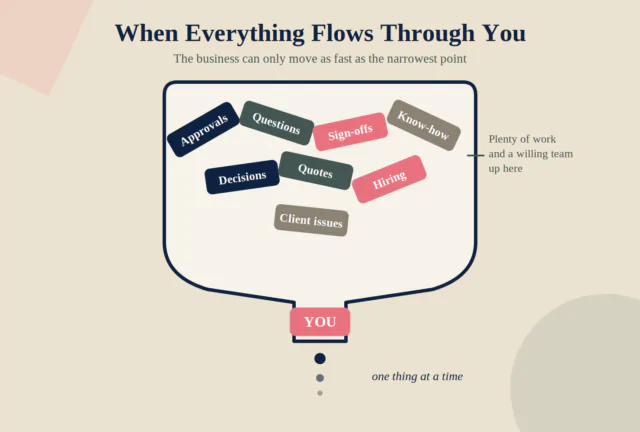
It rarely feels like a problem from the inside. It feels like being needed. That is exactly why it is easy to miss, and why a simple checklist helps.
Why owners become the bottleneck
In the early days, doing everything yourself is how the business survives. The habits that got you started, like answering every question and checking every detail, quietly become the ceiling once the business grows.
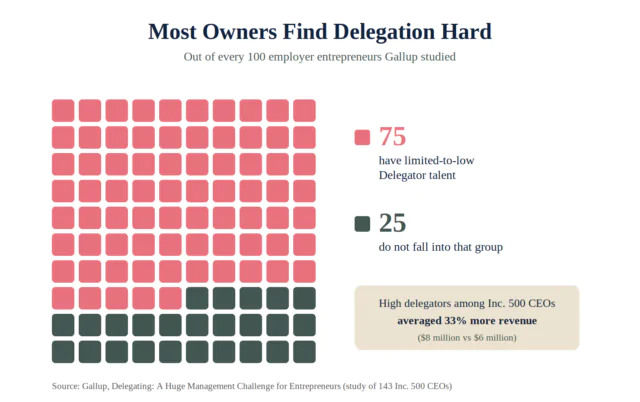
Gallup’s research on entrepreneurs puts numbers on this. It found 75% of the employer entrepreneurs it studied have limited-to-low Delegator talent. In a separate study of 143 Inc. 500 CEOs, those with high Delegator talent averaged $8 million in revenue against $6 million for low delegators, and grew faster over three years.
That study covers fast-growing companies, not every small business. The lesson still carries over: the owners who grow are usually the ones who stop holding every decision themselves.
The 5 signs you are the bottleneck
Score each sign as you read: 0 if it rarely happens, 1 if it happens sometimes, 2 if it happens often.
1. Work sits waiting for your approval
Quotes, invoices, social posts and hiring decisions pile up until you find time to look at them. Your team is not stuck because they lack skill. They are stuck because nothing moves without your sign-off.
McKinsey’s survey on decision making found respondents spend 37% of their time making decisions, and only 48% said their organizations make decisions quickly. It also found faster decisions tend to be better ones, not worse. In a small business, every day a quote waits on you is a day a competitor can answer first.
The fix: set approval limits. Decide which decisions your team or assistant can make alone, which need a quick check and which truly need you.
2. Your team asks before they act
If your phone lights up all day with “quick questions,” people have learned that asking you is safer than deciding. Each question takes a minute to answer, but together they fill your day and train the team to wait. Listen for “I just wanted to check with you first.” It usually means the rules are missing, not the ability.
The fix: answer each repeated question once, in writing. Turn it into a rule or a short guide so the next person can find the answer without you.
3. You are the only one who knows how things work
Passwords, client preferences, pricing logic and vendor contacts all live in your head. That makes you irreplaceable in the worst way: nobody else can step in, even for routine work. It is also a risk: if you are out sick for a week, that knowledge goes with you.
The fix: record yourself doing each recurring task once. A five-minute screen recording with a short checklist is enough to hand most admin work to someone else.
4. You cannot take a day off without checking in
A survey highlighted by SCORE found 67% of small business owners check in with their business at least once a day on vacation, and only 15% fully disconnect. The survey is several years old, but most owners will recognize the pattern. If you are in the 67%, the business is telling you something.
The fix: run a one-day test. Plan a day away, list what would break and fix those gaps first. Each gap is something to document or hand over.
5. Growth work stops when you get busy
When delivery gets heavy, sales calls, marketing and follow-ups quietly stop. Then work dries up, you switch back to selling, and the cycle repeats. That feast-and-famine pattern is a classic bottleneck sign.
The fix: protect a fixed block of growth time every week and hand the admin that competes with it, such as scheduling, inbox and CRM updates, to someone else. That combination is what executive assistant services are built around.
Your bottleneck score
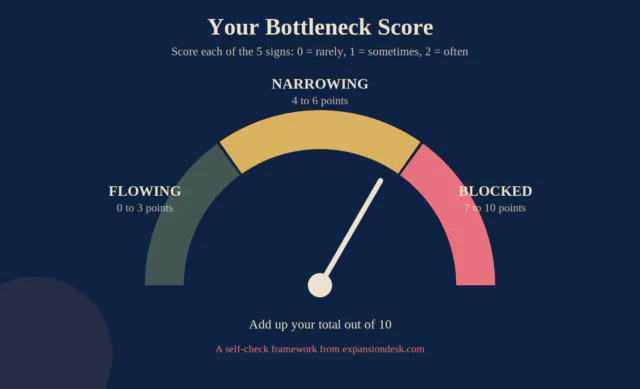
Add up your five scores for a total out of 10.
| Score | What it means | What to do next |
|---|---|---|
| 0 to 3 | Flowing | Work moves without you most of the time. Keep documenting as you grow. |
| 4 to 6 | Narrowing | Some work waits on you. Pick your highest-scoring sign and fix it this month. |
| 7 to 10 | Blocked | The business is waiting on you. Start with approval rules and hand off routine admin. |
What this looks like in practice
The example below is a hypothetical scenario to illustrate the process. It is not a real client.
Marcus runs a 12-person landscaping company. He scores 8 out of 10. Every quote needs his review, crews call him with scheduling questions and he has not taken a full day off in two years.
He starts with sign 1. He sets a rule that standard quotes under an agreed size go out without his review, and his assistant prepares and sends them. Next he records how he schedules crews, and the assistant takes over the calendar. Within a quarter, Marcus is spending his mornings on commercial contracts instead of answering scheduling calls.
Nothing about his crews changed. Their questions simply have somewhere else to go now.
When being the bottleneck is fine
Not every bottleneck is a problem. Some things should stay with the owner:
- Major pricing and strategy decisions
- Key client relationships in their early stages
- Hiring your first few core team members
- Anything with serious legal or financial risk
The goal is not to remove yourself from everything. It is to make sure routine work never waits on you.
How to stop being the bottleneck
- Score yourself using the five signs above.
- Start with your highest-scoring sign, not all five at once.
- Write approval limits so routine decisions happen without you.
- Document recurring tasks with short recordings and checklists.
- Hand routine admin to a trained assistant so your time goes to growth.
- Re-score in 60 days and move to the next sign.
Once the first fixes are in place, this guide to building a delegation system shows how to make it stick as the team grows.
Frequently asked questions
What does it mean to be the bottleneck in your business?
It means work regularly waits for you, whether that is your approval, your answer, your knowledge or your time. The business can only move as fast as you can personally handle things.
How do I know if I am the bottleneck?
Look for five signs: work waiting on your approval, a team that asks before acting, knowledge only you have, not being able to take a day off, and growth work stopping when you are busy. Score each from 0 to 2 to see where you stand.
Why do business owners become bottlenecks?
Usually because the habits that helped the business start, like handling everything personally, never get replaced as it grows. Gallup also found most employer entrepreneurs have limited-to-low natural talent for delegation.
How do I stop being the bottleneck?
Start with the sign that scores highest. Set clear approval limits, document recurring tasks, protect time for growth work and hand routine admin to someone else. Fix one sign at a time rather than everything at once.
Do I need to hire more people to fix it?
Not always. Often the issue is how work flows, not how many people you have. This breakdown of a staffing problem versus a capacity problem explains the difference.
Can a virtual assistant help if I am the bottleneck?
Yes, for the routine side of the problem. A virtual assistant can take over scheduling, inbox, quote preparation and follow-ups once you have written rules. Strategic decisions and key relationships should stay with you.
What to do next
Take the self-check honestly. If you scored 4 or more, pick one sign and fix it this month. For a deeper look at what staying the bottleneck costs over time, read the hidden cost of being the bottleneck in your business.
Expansion Desk helps owners hand routine work to trained assistants so the business stops waiting on one person. See how a virtual assistant for small business could take the first few tasks off your plate.
Scored 7 or higher? Book a free discovery call and talk through where to start.
Sources
- Gallup, Delegating: A Huge Management Challenge for Entrepreneurs. news.gallup.com
- McKinsey and Company, Decision Making in the Age of Urgency (Global Survey). mckinsey.com
- SCORE, Summer’s Almost Over. Did You Take Time Off Yet? (citing an OnDeck survey of small business owners). score.org

- What Nobody Tells You Before You Hire Your First Virtual Assistant - October 5, 2026
- 5 Signs You Are the Bottleneck in Your Own Business - October 1, 2026
- The One Task Costing You the Most Time Every Week (and How to Fix It) - September 30, 2026