

You finish eight things on Monday and feel great. By Wednesday the list is longer than it was on Sunday night. By Friday, half of last week’s items are still sitting there, quietly rewritten onto a new page. If your to-do list never gets shorter, you are far from alone.
Most owners blame themselves for this: not enough discipline, not enough hours, the wrong app. The real cause is simpler, and it is not about effort. It is about flow, and it is the reason many owners eventually look for virtual assistant support rather than a better planner.
Here is what the research says about why to-do lists keep growing, the four kinds of items that clog them and a simple way to make your list actually shrink.
Executive summary
- Your to-do list never gets shorter because more goes in than comes out. When every request lands on one person, the inflow will always beat the outflow.
- Most of the day is not spent on the list itself. Asana’s 2023 research found 58% of the average workday goes to work about work, with only 9% left for strategic work.
- We consistently underestimate how long things take. In a classic study, students predicted a project would take about 34 days. It took about 56, and only 30% finished by their own estimate.
- Unfinished items cost attention even when you are not working on them. Research shows that making a specific plan for a task reduces the mental nagging it causes.
- The fix is to change the flow, not to try harder. Turn recurring tasks into systems, break vague items into actions and move items that do not need you to someone else.
Why does your to-do list never get shorter?
Your to-do list never gets shorter because new tasks arrive faster than one person can complete them. Requests, follow-ups and ideas keep flowing in, while only you can close them. Add vague items, recurring chores that never truly end and tasks that take longer than planned, and the list grows no matter how hard you work.
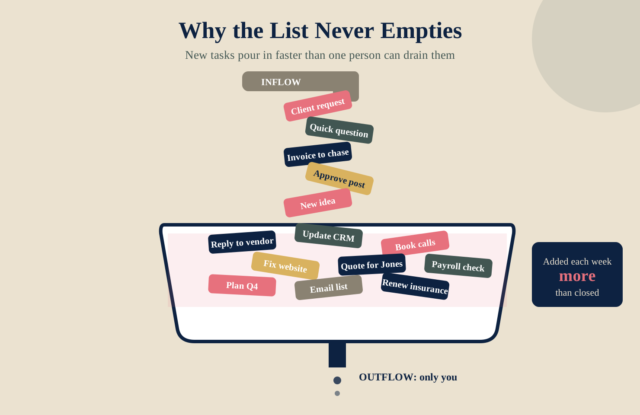
Think of your list as a bathtub. Requests, emails and ideas pour in from the tap. The only drain is you. If the tap runs faster than the drain, the tub fills, and working faster only buys you a little time before it overflows again.
3 forces that keep your to-do list growing
1. The day goes to work about work
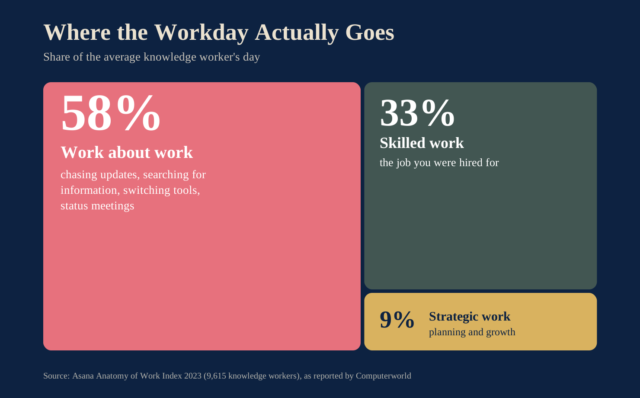
Asana’s 2023 Anatomy of Work Index, a survey of 9,615 knowledge workers, found the average person spends 58% of the workday on work about work: chasing updates, searching for information, switching between tools and sitting in status meetings. Only 33% goes to the skilled work people were hired to do, and just 9% to strategic work.
For an owner, that means most of the day is spent moving work around rather than finishing it. The list does not shrink because the hours that could close items are being used up by coordination.
2. Everything takes longer than you think
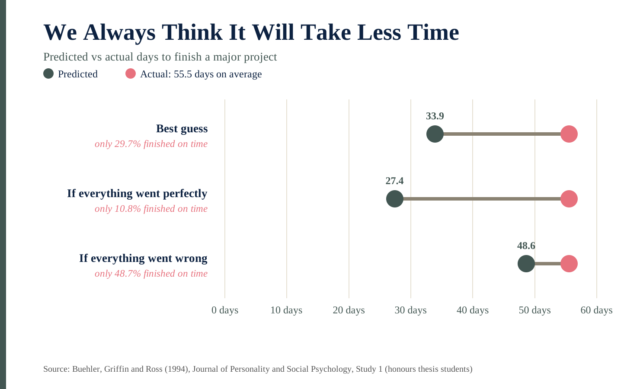
Psychologists call this the planning fallacy. In a well-known 1994 study by Buehler, Griffin and Ross, students estimated their thesis would take about 34 days. It actually took about 56, and fewer than a third finished by the date they predicted. Even their worst-case estimates were too optimistic: fewer than half finished in that time.
The study looked at students, not business owners, but the pattern is the same anywhere. When every task takes longer than planned, a daily list built on optimistic guesses is guaranteed to spill into tomorrow.
3. Unfinished items keep tapping you on the shoulder
Open loops do not stay quietly on the page. Research by psychologists E.J. Masicampo and Roy Baumeister found that unfinished goals keep intruding on people’s thoughts. However, making a specific plan for when and how to do the task reduced that mental nagging, even before the task was done.
A long list of vague, unplanned items is therefore not just a to-do list. It is a constant background noise that makes the work you are actually doing harder to focus on.
The 4 kinds of items clogging your to-do list
When owners audit their lists, the same four types of items keep showing up. Each one needs a different fix.
| Item type | Example | Why it never leaves | The fix |
|---|---|---|---|
| Recurring chores | Send invoices, post on social, update the CRM | It is never finished, only done for this week | Turn it into a system or hand it over |
| Vague projects | Sort out the website, fix onboarding | It is a project, not a task, so there is no clear first step | Break it into one next action |
| Other people’s requests | Quick favors, approvals, questions | It arrived from someone else and defaulted to you | Set rules for who handles what |
| Decisions waiting on you | Approve the quote, choose a supplier | Nothing moves until you decide | Batch decisions into a set time each week |
If many of your items are decisions waiting on you, the list is also a sign that work is queuing behind one person. That pattern is covered in more depth in the hidden cost of being the bottleneck in your business.
What most owners try, and why it does not work
- A new app. Better tools organize the list, but they do not change how many items arrive or who has to finish them.
- Working longer. Extra hours drain the tub a little faster for a while, then tiredness slows everything down again.
- Rewriting the list. Copying items to a fresh page feels like progress, but it only moves the same problem forward a day.
Each of these treats the list as the problem. The list is just the symptom. The real reason your to-do list never gets shorter is that too much work has only one place to go.
How to make your to-do list shorter
Use this five-step flow audit. It takes one week to run and changes how the list works, not just how it looks.
- Count the inflow. For one week, note every item added to your list and where it came from.
- Count the outflow. Note every item you closed. If more went in than came out, you have found the real problem.
- Label each open item as a recurring chore, a vague project, someone else’s request or a decision waiting on you.
- Apply the fix for each type. Systems for chores, one next action for projects, rules for requests and a weekly decision block.
- Move items that do not need you. Anything recurring, rule-based and easy to check is a candidate to hand over.
Step five is where the list finally starts shrinking, because it adds a second drain. Inbox management, scheduling and follow-ups are usually the first items to move, which is what executive assistant services are built around.
If the audit shows the problem is simply more work than one person can handle, it may be a capacity issue rather than a hiring issue. This breakdown of a staffing problem versus a capacity problem explains the difference.
What this looks like in practice
The example below is a hypothetical scenario to illustrate the process. It is not a real client.
Nina runs a small marketing studio. Her list has 47 open items. She runs the flow audit for a week and finds she added 38 items and closed 29. Of the 47 open items, 18 are recurring chores, 9 are vague projects and 12 are other people’s requests.
She turns the vague projects into single next actions, sets a rule that client scheduling requests go to her assistant and hands over three recurring chores: invoicing, social posting and CRM updates. Within a few weeks, the number of items she closes is higher than the number that arrive. For the first time in months, the list is getting shorter.
When a longer list is fine
Not every long list is a problem. A list can be long because the business is growing, a launch is coming or you are capturing ideas for later. The warning sign is not length. It is a list that grows every week while the important items stay untouched. If you are not sure whether outside help would change that, read is hiring a virtual assistant worth it.
Frequently asked questions
Why does my to-do list keep getting longer?
Because more tasks are added than completed. When requests, follow-ups and ideas all land on one person, the inflow almost always beats the outflow, especially when tasks take longer than planned.
How do I make my to-do list shorter?
Track what goes in and what comes out for a week. Then turn recurring chores into systems, break vague projects into single next actions, set rules for other people’s requests and hand over tasks that do not need you.
Why do I never finish my to-do list?
Most people underestimate how long tasks take, a pattern psychologists call the planning fallacy. Much of the day also goes to coordination rather than finishing work. Together, that means a daily list built on optimistic estimates rarely gets completed.
Is a long to-do list bad?
Not always. A long list can simply capture ideas. It becomes a problem when it grows every week, the important items stay untouched and unfinished tasks keep pulling your attention away from what you are working on.
What should I take off my to-do list first?
Start with recurring chores that follow clear rules, such as invoicing, scheduling, CRM updates and social posting. They never truly finish, so they keep reappearing until someone else owns them.
Can a virtual assistant help with my to-do list?
Yes, for the routine part of it. A virtual assistant can own recurring tasks, handle routine requests and follow up on open items, which adds a second drain to your list. Decisions and key relationships should stay with you.
What to do next
If your to-do list never gets shorter, run the flow audit for one week. Count what goes in, count what comes out and label every open item. The numbers will tell you whether the answer is a better system, a clearer rule or a second pair of hands.
Expansion Desk matches business owners with vetted, trained assistants, with a dedicated onboarding support team behind them. See how a virtual assistant for small business can take recurring items off your list for good.
Ran the audit and found more going in than coming out? Book a free discovery call and bring your list.
Sources
- Asana, Anatomy of Work Index 2023, as reported by Computerworld. computerworld.com
- Buehler, Griffin and Ross, Exploring the Planning Fallacy, Journal of Personality and Social Psychology, 1994. warrington.ufl.edu
- Masicampo and Baumeister, Consider It Done! Plan Making Can Eliminate the Cognitive Effects of Unfulfilled Goals, Journal of Personality and Social Psychology, 2011, summarized by Psychology Today. psychologytoday.com

- How to Do a Time Audit as a Business Owner (Free Template) - November 11, 2026
- Everyone Is Talking About AI Taking Over Small Business, Here Is What Is Actually True - November 4, 2026
- What Successful Business Owners Do Differently When They Scale - November 4, 2026